
GEO
A plain-English definition of Generative Engine Optimization, how GEO relates to SEO, and how I use it when reviewing SeoGeo Tech.

Generative Engine Optimization (GEO) is the practice of making useful web content easier for generative search and answer systems to retrieve, interpret, summarize, and attribute accurately. In practice, that usually means clear answers, reliable evidence, understandable page structure, consistent entities, and a technically accessible page. It does not provide a way to force an AI citation.
I originally wrote this page because I wanted one uncomplicated explanation of GEO on SeoGeo Tech. The site also has a much deeper Technical GEO implementation guide. That guide is about HTML, canonical metadata, structured data, internal links, and validation. This page has a narrower job: explain what GEO means, how it relates to SEO, and how I use the idea when reviewing content.
Why I revisited this definition
After publishing the first version, I checked the page in Google Search Console rather than judging it by how complete it looked. Over three months, the page received impressions for definition-led queries including “what is generative engine optimization,” “how does generative engine optimization work,” and “generative engine optimization definition.” The leading query had 480 impressions and no clicks in the screenshot below.
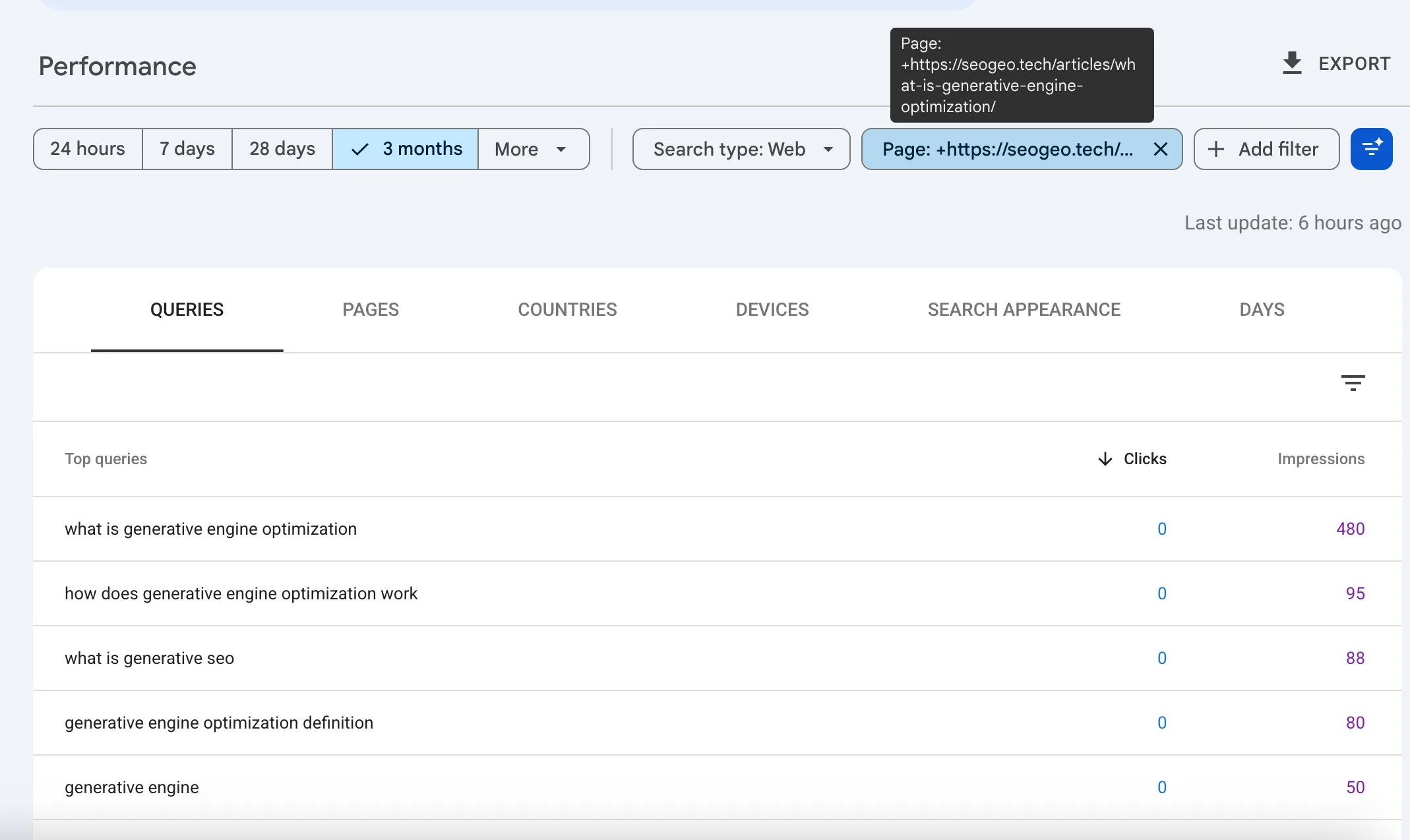
My conclusion was not “add every phrase to the page.” The queries mainly share one intent: readers want a definition and a plain explanation of how GEO works. That supports keeping this URL as the definition page. It also tells me not to turn it into a second Technical GEO manual.
The 480 impressions and zero clicks did not persuade me to make the article broader. The definition is already stated near the top, so adding more GEO terminology would not explain the result. Before changing the page again, I need to review average position, the search results shown for the query, competing definitions, the title and snippet, and whether Google is presenting the intended URL. The screenshot identifies a performance question; it does not diagnose the cause.
How GEO relates to SEO
SEO and GEO overlap, but I do not use the terms interchangeably. A page cannot become useful to AI-assisted search if it is inaccessible, poorly linked, or unclear to ordinary search systems. GEO begins on top of that foundation; it does not replace it.
For this definition page, the boundary is enough: SEO helps the right page become discoverable and understandable in search, while GEO asks whether the answer, evidence, context, and limitations can be reused without losing their meaning. I explain how I separate the two during an actual page review in SEO vs GEO: A Practical Comparison.
What GEO changes on an actual page
Make the answer explicit. A definition page should answer the defining question before expanding into history, tactics, or related terminology.
Keep evidence close to claims. Important recommendations should have a source, example, test result, screenshot, or clearly labeled editorial basis nearby.
Preserve context and limitations. A statement should still be accurate if a search or answer system retrieves only that section rather than the full article.
Keep the source page technically accessible. The main content still needs usable HTML, internal links, one clear canonical URL, and an ordinary SEO foundation. The detailed implementation belongs in the Technical GEO guide.
A small example
GEO is important because AI is changing search, so every business should optimize content for AI.
GEO is a review layer for making useful web content easier to retrieve and summarize accurately. On a definition page, that may mean stating the term early, explaining its boundary with SEO, supporting claims, and linking to a separate implementation guide instead of repeating it.
What GEO does not prove
- A clear definition does not guarantee an AI citation.
- Structured data does not replace visible, useful content.
- An AI Overview screenshot is an observation from a particular query, place, device, and time—not a permanent ranking.
- More headings or more words do not automatically make a page easier to use.
Where to go next
If you only needed the definition, the working idea is simple: GEO makes useful content easier to interpret and reuse accurately in generative search, while preserving the SEO foundation. For implementation details, continue with the Technical GEO guide. To decide whether a problem belongs to the search foundation or the answer-readiness layer, use the SEO vs GEO comparison.