
Structured Data
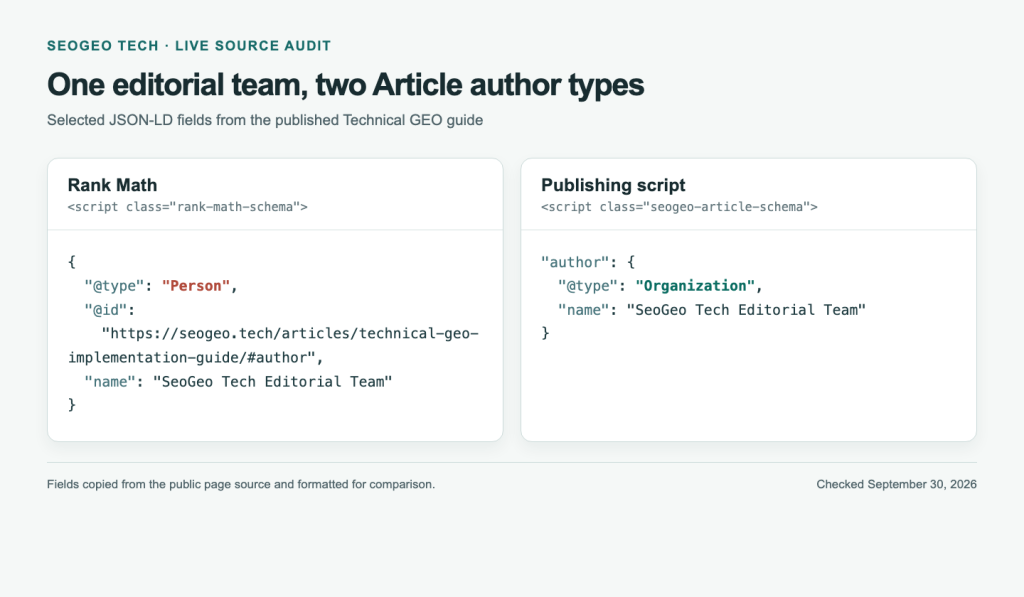
While checking the live source of one SeoGeo Tech article, I found two Article JSON-LD outputs describing the same editorial team in different ways. This is what was actually in the page source.
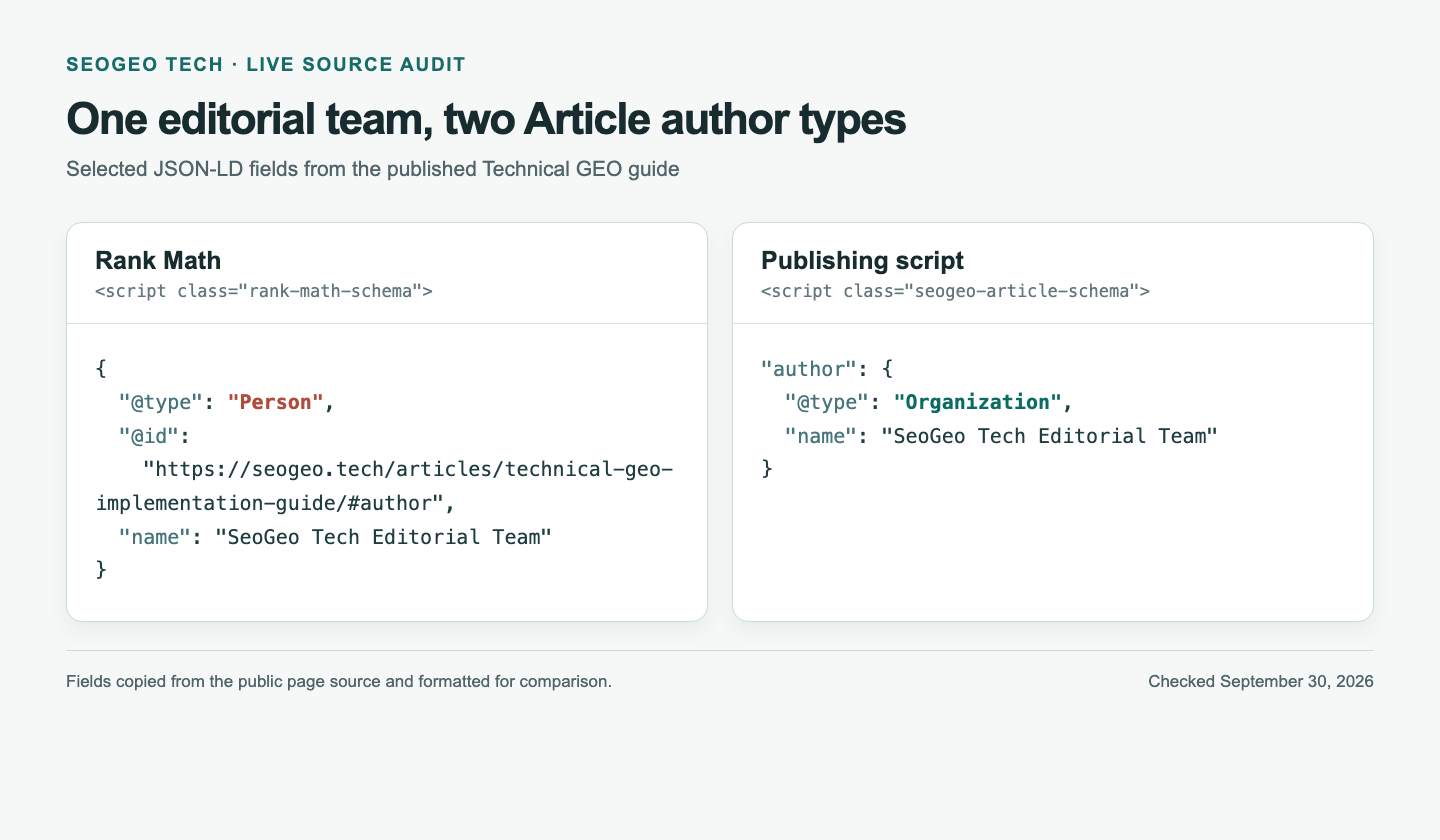
On September 30, 2026, I opened the published HTML of SeoGeo Tech’s Technical GEO guide and searched for its application/ld+json scripts. That check was more useful than another perfect-looking sample: the page had two Article descriptions, and they disagreed about what kind of author “SeoGeo Tech Editorial Team” is.
Open the source comparison at full size if the text in the image is too small on your screen. The relevant JSON-LD fields are also reproduced below as text.
What I found in the page source
Rank Math generated an Article node that references this author node:
{
  "@type": "Person",
  "@id": "https://seogeo.tech/articles/technical-geo-implementation-guide/#author",
  "name": "SeoGeo Tech Editorial Team"
}
The Article node inserted by SeoGeo Tech’s WordPress publishing script described that same name this way:
{
  "@type": "Organization",
  "name": "SeoGeo Tech Editorial Team"
}
These are selected objects from the September 30 response, not complete scripts to paste onto another site. The presence of two Article nodes was not, by itself, the problem. What made me stop was that the same editorial team was described as a Person in one output and an Organization in the other. Our About page describes editorial responsibility as a team, not an individual author biography.
Why this happened on my site
Rank Math produces one Article node as part of its JSON-LD graph for the WordPress page. Separately, SeoGeo Tech’s publishing script inserts a second Article object into the article content. Each output looks plausible when read alone. The mismatch became clear when I searched the final HTML for every application/ld+json block and compared both Article outputs side by side.
The date fields also need care. In Rank Math’s graph, the WebPage node has timestamps with timezone offsets; its Article node has no separate dates. The publishing script’s Article node uses calendar dates from our article data. I have not called the different-looking dates wrong without comparing the underlying times and the visible page record.
The author-type correction, checked October 24
We kept both Article outputs and installed a small WordPress plugin using Rank Math’s rank_math/json_ld filter. It targets the named editorial-team author node referenced by an Article on our article pages, changing its type from Person to Organization. It does not change individual authors, standalone pages, the publisher node, or stored article content and dates.
I fetched the Technical GEO guide again after installation. Its Rank Math author node now contains these fields:
{
  "@type": "Organization",
  "@id": "https://seogeo.tech/articles/technical-geo-implementation-guide/#author",
  "name": "SeoGeo Tech Editorial Team"
}
The publishing script’s Article author was already an Organization. Comparing the saved before-and-after HTML showed one JSON-LD field change: the Rank Math author type. The rest of that page’s HTML was unchanged. This resolved the author-type mismatch without republishing the Technical GEO article.
Two systems still produce Article markup, so future changes need checks against both outputs. This follow-up verifies the live source; I have not recorded a new Rich Results Test result or a Google recrawl.
Why the mismatch matters
Google’s Article documentation allows an author to be either a Person or an Organization, but recommends using the appropriate type and a URL that helps identify the author. Organization was not the invalid choice here. The issue was that the same editorial team was represented differently by two Article outputs.
I would not treat a passing Rich Results Test as proof that the implementation is finished. Google’s structured data guidelines do not guarantee a particular search appearance, and its guidance for AI search features does not require special schema. For this page, I see an identity and maintenance issue—not an AI-visibility trick.