

GEO
A real GEO case study documenting how my website, SeoGeo Tech, appeared in Google AI Overview and Google AI Mode, what I observed, what may have helped, and what I'll continue tracking.
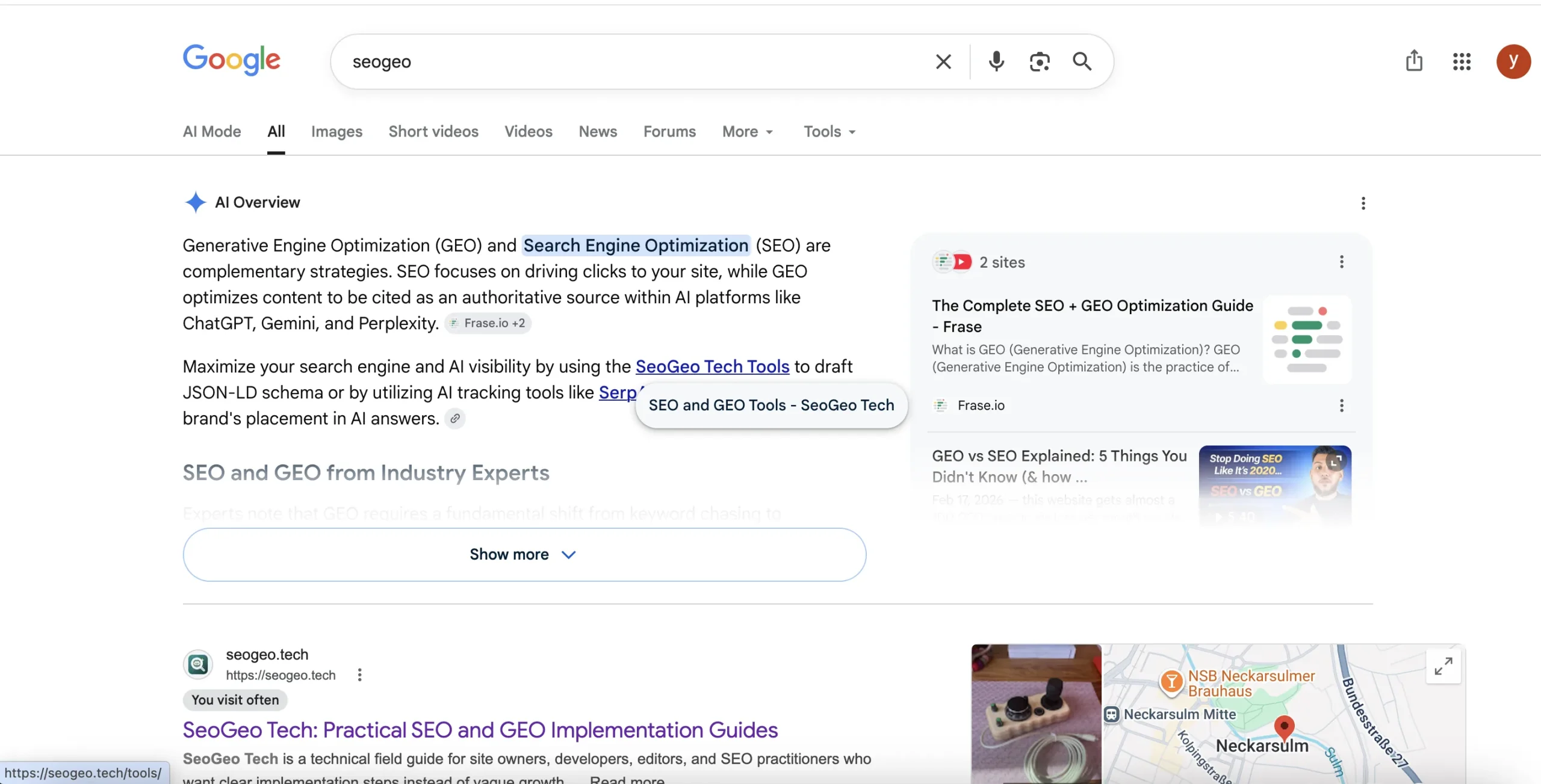
A few days ago, I noticed something interesting: SeoGeo Tech appeared in Google AI Overview and Google AI Mode for searches around “seogeo.”
For a small technical website that is still being built in public, it was worth documenting. In this case study, I’ll use SeoGeo Tech as the example throughout the article.
SeoGeo Tech focuses on SEO, GEO, AI search, structured data, and technical publishing. Seeing it appear inside Google’s AI search experience gave me a reason to look at what happened, what may have helped, and what I should track next.
The goal of this article isn’t to explain how to get into Google AI Overview. It’s to document one real observation and share what I learned from it.
This article documents a real observation from a single website. Google AI Overview and AI Mode are dynamic features, and results can vary by query, location, language, device, account, and time. Nothing in this article should be interpreted as a guaranteed method for appearing in AI-generated search results.
Timeline of This GEO Case Study
This is not meant to be a final success story. It is a living note that I can update as the site changes and as Google’s AI search experience evolves.
- Website launched
- Google indexed more pages
- Some pages started ranking for relevant queries
- SeoGeo Tech appeared in Google AI Overview
- SeoGeo Tech appeared in Google AI Mode
What I Searched for This Google AI Overview Test
The query was simple:
seogeoI intentionally chose the query “seogeo” because it is closely related to my website’s primary topic. I checked Google Search, Google AI Overview, and Google AI Mode on July 13, 2026. The important caveat is that these results are not fixed. Another person may see a different AI Overview, a different set of sources, or no AI Overview at all.
What Appeared in Google AI Overview
In one AI Overview, Google interpreted the query as related to SEO and GEO, where GEO means Generative Engine Optimization. The generated answer described SEO and GEO as complementary strategies and included a link to SeoGeo Tech Tools.
That matters because the link appeared in the AI Overview context, not only as a regular organic result below the answer. I would still describe this carefully: it is a surfaced link in an AI-generated search experience, not proof that the site has stable AI visibility.
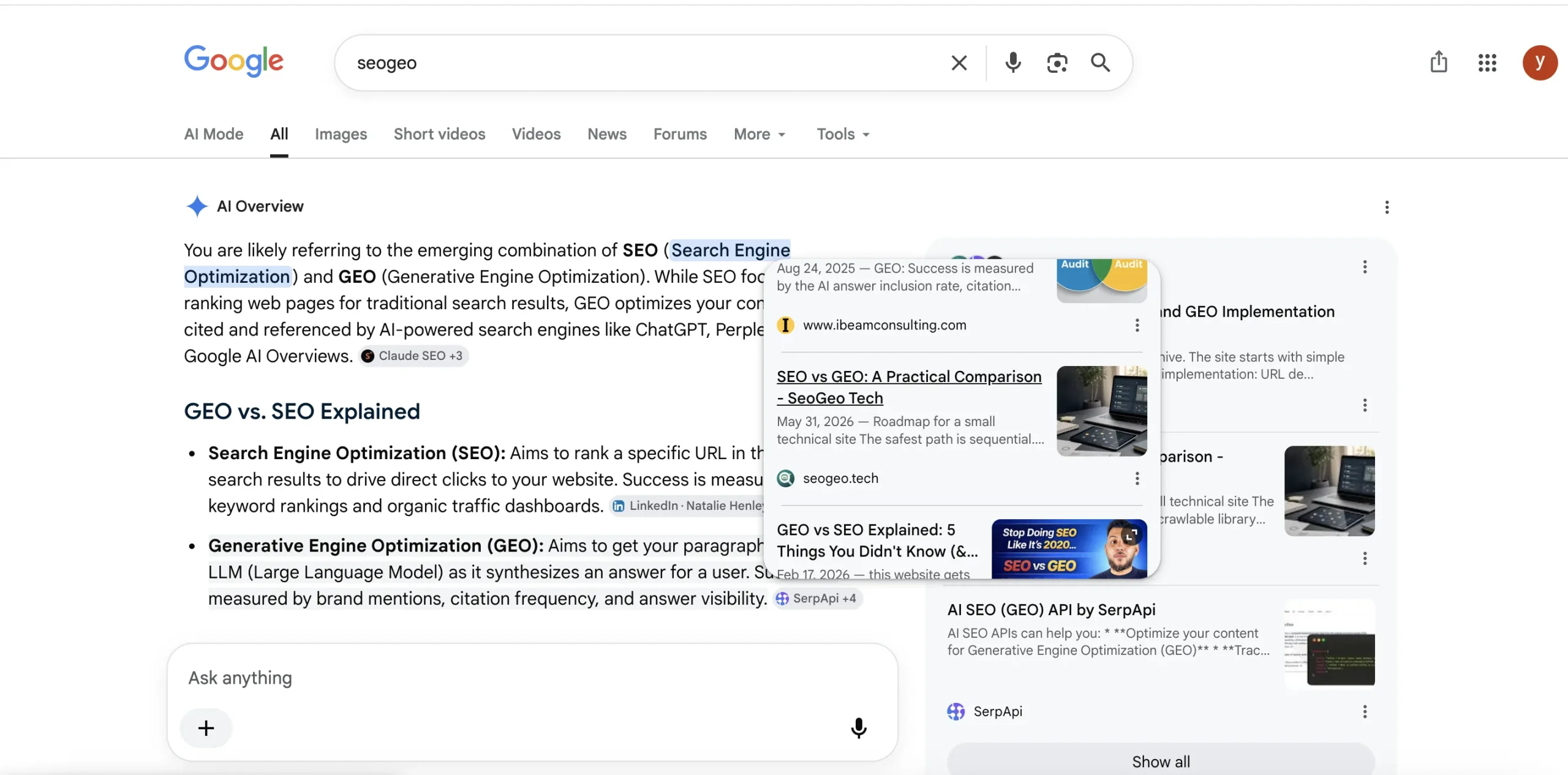
In another result, Google surfaced my article SEO vs GEO: A Practical Comparison in the source-style area connected to the AI Overview. That page is a natural match for the query because it explains the difference between traditional SEO and Generative Engine Optimization in practical terms.
What Appeared in Google AI Mode
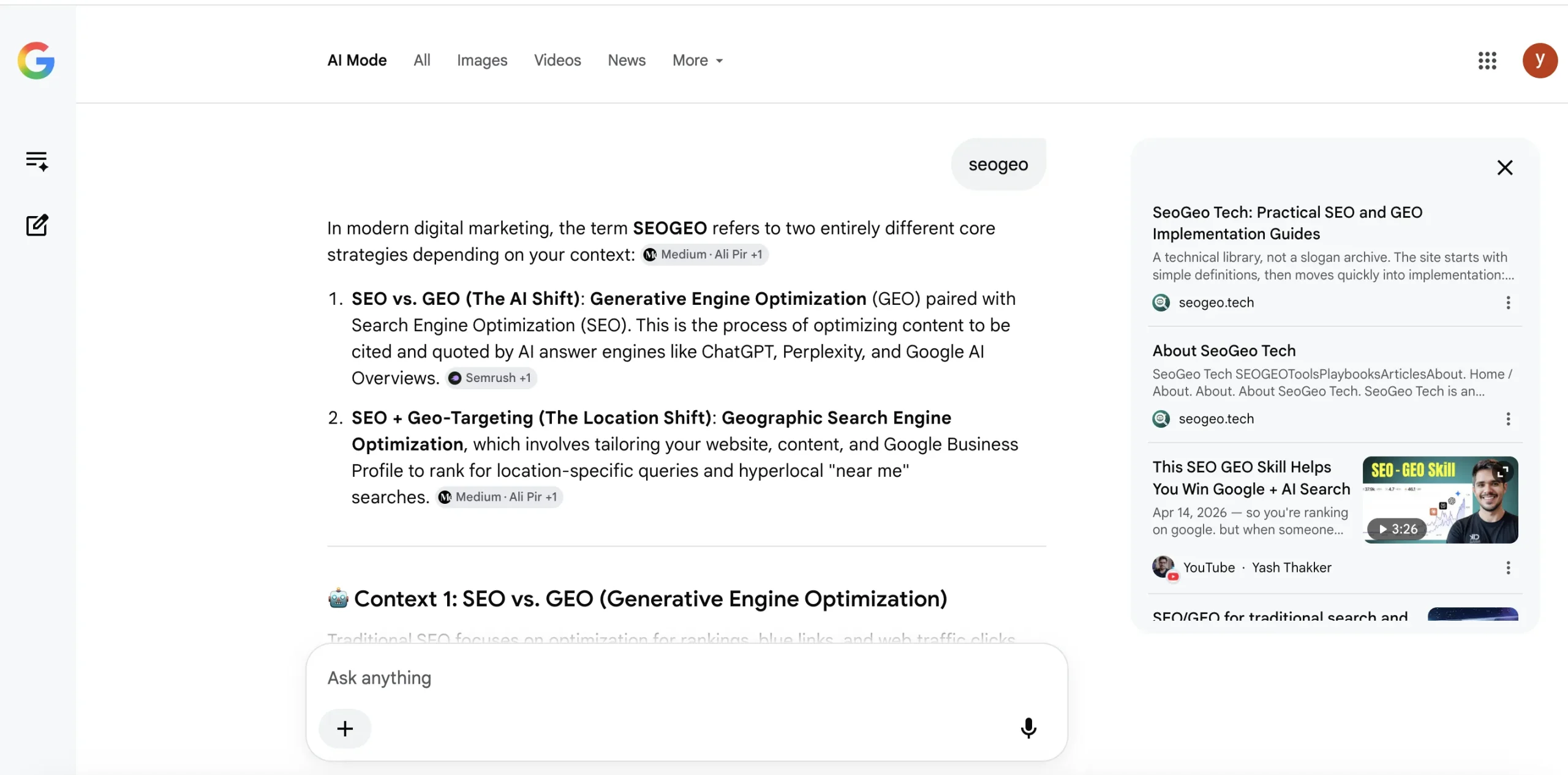
I also checked Google AI Mode. In that experience, SeoGeo Tech appeared in the right-side source panel for the broader “seogeo” query. This is slightly different from an inline AI Overview link, so I do not want to overstate it. The safer way to describe it is that Google AI Mode associated SeoGeo Tech with the query context and displayed it as a related source.
Why This Matters for GEO
GEO is often discussed in theory. People talk about AI citations, AI visibility, answer engines, and AI search optimization. Those topics are important, but they can become vague fast. A small real example is useful because it gives me something concrete to inspect.
This case does not prove a ranking factor. I cannot know exactly why Google selected these pages. Instead, I see it as a practical observation worth studying:
- What type of page did Google surface?
- Was the site clearly focused on the topic?
- Did the page answer the query directly?
- Were related pages connected through internal links?
- Were the normal SEO basics already clean?
That is the healthiest way for me to think about GEO. It is not a shortcut. It is the work of making pages clearer, more useful, and easier to understand.
What May Have Helped Google Understand My Website
I do not want to claim a cause-and-effect relationship, but a few things may have helped Google connect SeoGeo Tech with this query.
Clear topical focus
SeoGeo Tech is not a general marketing blog. It is tightly focused on technical SEO, Generative Engine Optimization, AI search, structured data, metadata, canonical URLs, and SEO/GEO tools. That focus makes the site easier to classify than a broad site that publishes about every marketing topic.
That is only my observation, not evidence of a ranking factor.
Related supporting pages
The site does not rely on one article. It has a small topic cluster around SEO and GEO, including the GEO implementation guide, What Is Generative Engine Optimization?, Technical GEO Implementation Guide, SEO and GEO Tools, and AI Answer Visibility Measurement.
That matters because a single page can answer one question, but a connected group of pages can explain the surrounding topic.
Again, this is an observation from this case study, not evidence of a ranking factor.
Direct explanations
The surfaced pages use plain definitions, comparisons, examples, and practical next steps. AI-generated answers often compress information, so vague content is easier to flatten. Clear structure gives both readers and systems less room to misunderstand the page.
I would treat this as an editorial lesson, not proof of a ranking factor.
SEO basics before GEO
Before thinking about GEO, I had already worked on the basics: indexable pages, canonical tags, sitemap output, Article schema, internal links, descriptive titles and descriptions, mobile-friendly layouts, and image alt text.
This lines up with Google’s own guidance. Google says SEO best practices are still relevant for generative AI features in Search, and that these experiences use content from Google’s Search index. So I see GEO as something built on top of SEO, not a replacement for it.
This is a baseline observation, not a guarantee of AI visibility or a ranking factor.
What Was NOT Surfaced
Interestingly, not every page from SeoGeo Tech appeared in the screenshots I captured. That is useful, because it keeps the case study grounded.
For example, I did not see these pages surfaced in this specific check:
- Technical SEO Checklist
- llms.txt Guide
- Metadata Guide
That makes me think topical relevance matters more than simply having more content. Still, this is only a cautious interpretation from one snapshot, not a rule about how Google chooses AI search sources.
What I do not know yet
I do not know exactly why Google surfaced SeoGeo Tech in these AI results. I also do not know whether the same query will show the same sources tomorrow.
So I would not claim any of these:
- This method guarantees AI Overview citations.
- GEO is solved.
- One screenshot proves stable AI visibility.
- A small site can force its way into Google AI answers.
A more honest conclusion is this: SeoGeo Tech had enough topical relevance, page structure, and technical SEO foundation to appear in at least one real Google AI search experience. That is worth documenting, but it needs more tracking.
My GEO checklist after this result
After seeing these screenshots, I started using a simple clarity checklist for future GEO pages:
- Does the page answer the main query clearly?
- Does it define the topic in plain language?
- Does it include examples, not just abstract advice?
- Does it link to related supporting pages?
- Is the title aligned with search intent?
- Is the canonical URL correct?
- Is the page indexable?
- Does the schema match the visible content?
- Are images useful and described with alt text?
This is not a magic AI citation checklist. It is a clarity checklist. That makes it useful even if an AI Overview never appears.
What I will track next
Next, I want to watch whether SeoGeo Tech continues to appear for “seogeo,” whether other GEO-related queries surface my pages, which URL Google chooses most often, and whether Search Console shows changes in impressions.
I will also watch whether the Generative AI performance report becomes available for this property. Google’s Search Console documentation says the report can include impressions from AI Overviews and AI Mode when available. That kind of data would make this case study stronger than screenshots alone.
Lessons for small website owners
The biggest lesson is simple: do not treat GEO as a trick.
For a small site, the better approach is to build pages that are genuinely useful and easy to understand. Pick a clear topic area. Publish connected pages, not isolated posts. Explain terms directly. Use examples and comparisons. Keep limitations close to claims. Make internal links descriptive. Handle SEO basics first.
If an AI system summarizes your content, what survives? The definition? The caveat? The example? The next step? That question is at the center of GEO.
GEO is less about trying to influence AI and more about making content easier for AI to understand.
Conclusion
Seeing SeoGeo Tech appear in Google AI Overview and AI Mode was a small but meaningful signal. It does not prove a formula. It does not guarantee future citations. But it does show why GEO is worth testing with real pages, real queries, and real screenshots.
For me, the next step is simple: keep building useful SEO and GEO resources, keep improving the site structure, and keep documenting what happens in public. This is only the beginning. As I collect more observations, I’ll continue updating this case study rather than drawing conclusions too early.