
Build in Public
Why SeoGeo Tech exists, why GEO matters in the AI search era, and how the site is being built in public with practical guides, free tools, GSC, GA4, and real experiments.
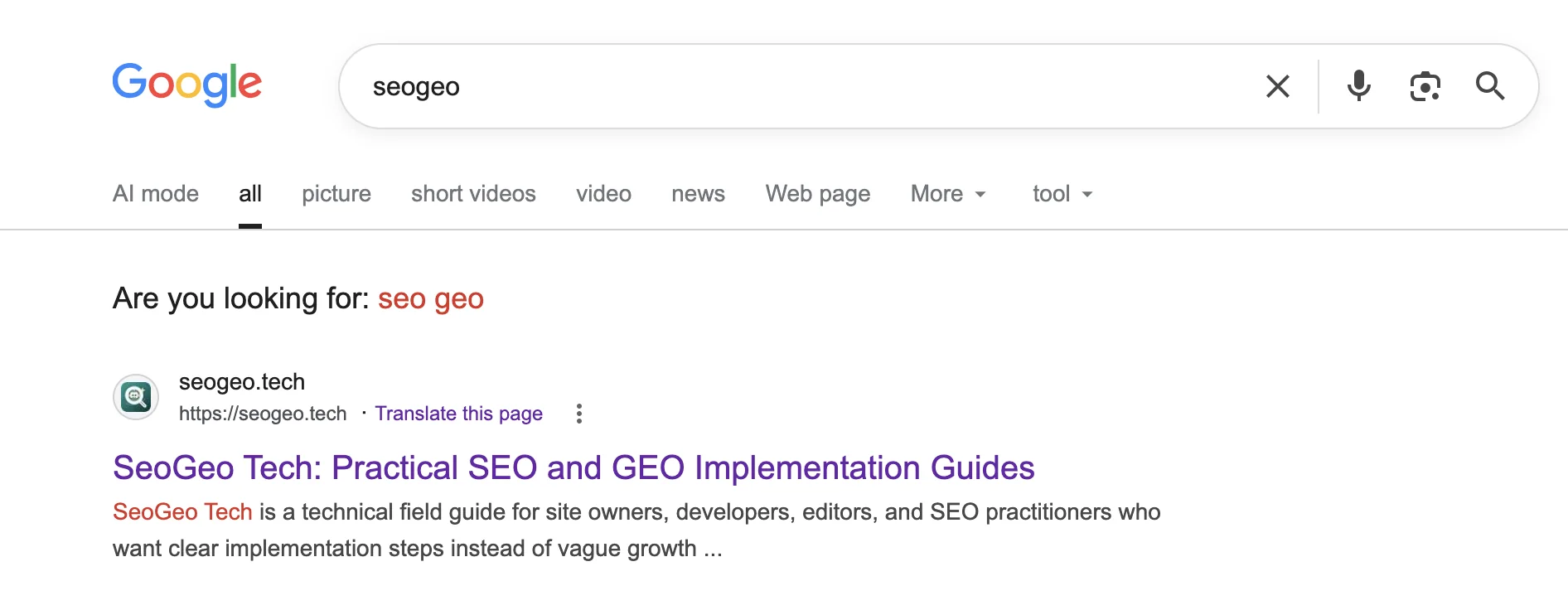
If you are reading this, welcome to SeoGeo Tech.
I created this site because I wanted to learn, build, and test in public. Not as a finished success story. Not as another SEO blog that rewrites the same advice. SeoGeo Tech is a small site I am building from zero while search itself is changing.
This is a living page. I expect to update it as the site grows, as the tools improve, and as AI search becomes a bigger part of how people find and understand information online.
Why another SEO site?
The web already has thousands of SEO tutorials, so that question is fair. My answer is that SeoGeo Tech is not meant to be a traditional SEO tips site. I want it to be a practical record of building for search in a period where classic SEO still matters, but AI search is becoming part of the discovery path.
SEO is not dead. Most sites still need the basics first: crawlable pages, useful titles, clear headings, canonical URLs, internal links, structured data, fast pages, and content that actually helps someone. Those things are still the foundation because they make a website easier for both people and systems to understand.
But search is no longer only a page of blue links. People now ask questions in ChatGPT, Gemini, Perplexity, Google AI Overviews, and other answer systems. Sometimes they click through. Sometimes they only read the generated answer. Sometimes they use AI to compare sources before deciding what to trust.
That shift is why I care about GEO.
From SEO to GEO
GEO stands for Generative Engine Optimization. I use it to describe the work of making useful web content easier for AI answer systems to understand, summarize, and cite without losing the important details.
To me, GEO does not replace SEO. It builds on it. A page still needs to be accessible, indexable, useful, and technically clean. The GEO layer asks a second question: if an AI system compresses this page into a short answer, what survives? The definition? The caveat? The source? The next step?
That is the space SeoGeo Tech is trying to explore: SEO as the base layer, GEO as the next layer of clarity, structure, and source value.
Why I created SeoGeo Tech
I did not create this site to pretend I have all the answers. I created it because the topic is moving fast, and I wanted a real website where I could test ideas instead of only talking about them.
The work started with ordinary steps: choosing the domain, planning the site structure, setting up Google Search Console and GA4, creating a sitemap, checking robots.txt, writing canonical tags, and publishing the first articles. None of that is flashy, but real websites grow through these small steps.
Over time, I want the site to show the process as well as the result: what I built, what changed, what I learned from Search Console and GA4, and what I will improve next.
What I am building here
SeoGeo Tech focuses on practical SEO and GEO implementation. The main topics are technical SEO, Generative Engine Optimization, AI search, AI Overviews, structured data, schema, metadata, content organization, and website architecture.
I also build free tools because some problems are easier to understand when you can check a real page. The JSON-LD Schema Generator helps create structured data. The Canonical URL & Meta Tag Checker helps inspect a page’s title, description, canonical URL, robots settings, and social metadata.
The goal is simple: turn ideas into things readers can use. A guide should explain the concept. A tool should make the problem visible. Together, they should help site owners, editors, developers, and SEO practitioners do better work.
Why build in public?
SeoGeo Tech did not start with a large audience or a mature data set. That is actually useful. It means I can document the early stages that many small sites go through: getting pages indexed, improving internal links, watching which queries appear, checking whether users interact with tools, and deciding what to update next.
I do not want to turn every small ranking change into a big success story. Early data is noisy. A few impressions do not prove a strategy. Traffic can move for many reasons. But real data can still point to useful questions: which page is unclear, which topic needs a better guide, which tool solves a real problem, and which internal link should exist.
That is the kind of build-in-public record I want this site to keep.
Why real experiments matter
SEO and GEO both attract confident advice. Some of it is good. Some of it sounds good until you try it on a real page. I want SeoGeo Tech to stay close to practice: rendered HTML checks, metadata checks, content structure tests, source notes, screenshots, Search Console observations, and tool behavior.
If an experiment fails, I want to record why. If something works, I want to explain the process, not just the result. That feels more useful than publishing a polished story after the messy part has been hidden.
How I see AI Search
I do not think AI search makes websites irrelevant. I think it raises the bar for what a useful website needs to provide.
Thin content is easier to ignore. Vague advice is easier to flatten. Unsupported claims are easier to lose. But clear pages with original examples, real tools, visible sources, and well-structured explanations still have a role.
For me, the future is not SEO versus GEO. It is SEO plus GEO: make the site technically sound, then make the content clear enough that people and answer systems can understand the same thing from the same page.
What comes next
Next, I will keep publishing practical guides, improving the free tools, and using Search Console and GA4 to decide what deserves more work. I also plan to share more build notes as the site grows, including what I change, what I test, and what I learn from the results.
If SeoGeo Tech helps you avoid a few mistakes, understand GEO more clearly, or ship a cleaner SEO implementation, then it is already doing part of its job.
Thanks for visiting. This is still early, and that is exactly why I want to document it.