

SEO and GEO, separated by practice
SeoGeo Tech is a technical field guide for site owners, developers, editors, and SEO practitioners who want clear implementation steps instead of vague growth advice.
SEO vs GEO
Two optimization jobs, one technical content system
SEO and GEO overlap, but they should not be treated as the same task. Start by making pages crawlable, indexable, and useful for searchers. Then structure the same content so answer engines can extract claims, limits, entities, and evidence without guessing.
Search Engine Optimization
SEO focuses on discovery and ranking signals: keyword intent, crawl paths, canonical URLs, metadata, structured data, internal links, speed, mobile usability, and clean index control.
- Make the page discoverable and indexable.
- Match titles, headings, and examples to real search intent.
- Keep technical signals consistent across HTML, sitemap, robots, and canonical tags.
Generative Engine Optimization
GEO focuses on answer extraction and trust: clear definitions, entity relationships, source blocks, caveats near claims, comparison tables, FAQ structure, and verifiable implementation notes.
- Make recommendations easy to summarize without distortion.
- Place scope, evidence, and limitations close to the claim.
- Write content that can be checked by a reader, crawler, or answer system.
Find a guide or tool for your next check
Check a page before publishing
Review crawl access, canonical URLs, structured data, and rendering in the technical SEO checklist.
Inspect a live URL
See the title, canonical URL, and robots directives returned by a public page.
Audit Article JSON-LD
See how two markup outputs described the same editorial team differently and how the mismatch was corrected.
Read a Search Console screenshot
Check which conclusions six visible page rows can support in a real AI search report.
Browse by topic
SEO, GEO, and publishing workflows
Follow the SEO or GEO guides by topic, or start with a specific publishing problem in Playbooks.
SEO Implementation
Crawlable architecture, keyword-to-page mapping, metadata, canonical rules, structured data, internal links, rendering, performance, and maintenance.
GEO Implementation
Entity clarity, answer extraction, evidence blocks, source-aware writing, FAQ design, llms.txt, AI-readable documentation, and visibility checks.
Playbooks
Choose a checklist, live example, or case study when you need to check a release, diagnose a publishing problem, or decide what to update.

Latest articles
Practical notes for search and AI visibility
Start with the SEO implementation checklist, then move into metadata, structured data, GEO content structure, and measurement.
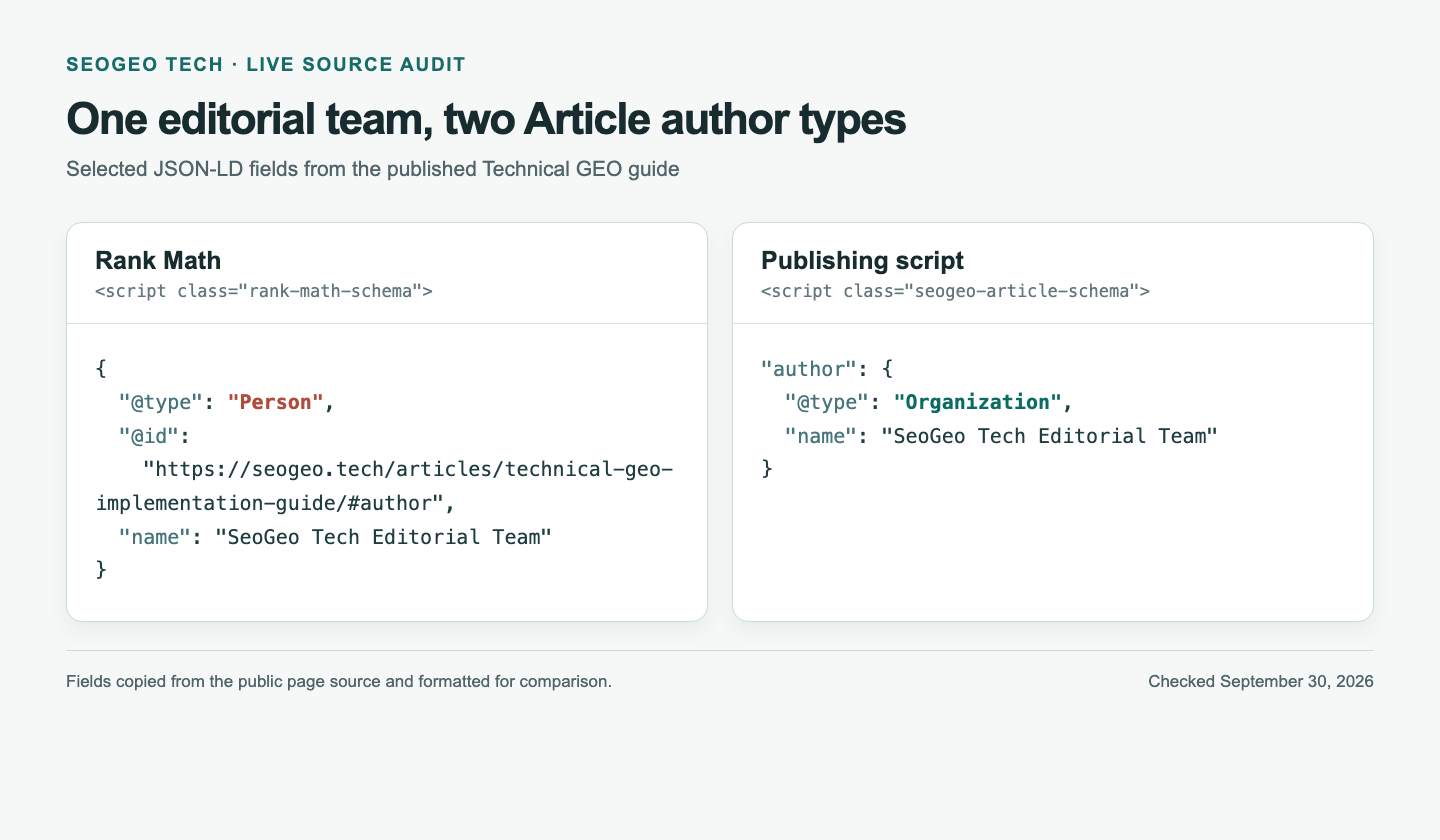
I Audited Our Article JSON-LD. Here’s What Was Wrong
While checking the live source of one SeoGeo Tech article, I found two Article JSON-LD outputs describing the same editorial team in different ways. This is what was actually in the page source.

Why My llms.txt Build Worked Locally but Failed in Production
My build produced llms.txt, but its public URL returned an article. The response checks that exposed the deployment gap, and how I verified the uploaded file.

GEO for Technical Documentation and Changelogs
A real publishing-script example shows why current usage instructions and historical release notes need different information.

Entity-First Content Architecture for GEO
How SeoGeo Tech distinguishes GEO, Technical GEO, and related tools without turning consistent terminology into repeated definitions.

What a Search Console Screenshot Can—and Cannot—Prove for GEO
One real Search Console screenshot shows why captions, visible values, and separately supplied information need to stay distinct.

Keyword Research That Turns Into a Page Map
A worked SeoGeo Tech page map: group related queries, choose an existing destination, and leave unsupported content ideas unassigned.
Good GEO is not about sounding machine-readable. It is about being precise enough that a person, crawler, or answer system can understand the same thing from the same page.