

Content Operations
How I use Search Console, page evidence, and manual review to decide whether to refresh an existing article, wait, or create a new page.
I no longer treat Publish as the end of an article. Once a page has had time to appear in Google Search Console, I use its real queries and page data to decide what the article needs next.
I first wrote this workflow because an article can have a good topic and still perform poorly. That does not automatically mean the topic failed. It may mean the page does not cover the observed intent clearly, the search result is not earning clicks, the wrong URL is appearing, or I simply do not have enough data yet.
The decision comes before the edit
My first question is not “What section can I add?” It is “What does the evidence justify?” I normally check these signals together:
| Signal | What it can tell me | What it cannot prove |
|---|---|---|
| GSC queries and impressions | Which search language and intent Google associates with the page. | That the page ranks well, deserves a rewrite, or caused a click problem. |
| Clicks and result presentation | Whether visible exposure is turning into visits, viewed with position and query context. | That the title alone is responsible for a low CTR. |
| Content Gap Analyzer | Whether the supplied query has explicit support in the title, headings, body, links, or evidence. | Rankings, AI citations, or whether every recommendation should be implemented. |
| Manual page review | Whether the content is useful, distinct, accurate, current, and easy to navigate. | Future search performance. |
| Manual AI Overview observation | How one generative result handled the topic at a specific time. | A stable AI ranking or universal visibility. |
What I learned from this page’s own GSC data
The GSC data for this article did not only contain clean queries such as “content refresh workflow” or “content refresh seo.” The largest visible queries asked which GEO platforms provide scheduled refresh workflows. That is a different intent: those searchers appear to want a product or platform comparison, while this page explains my editorial process.
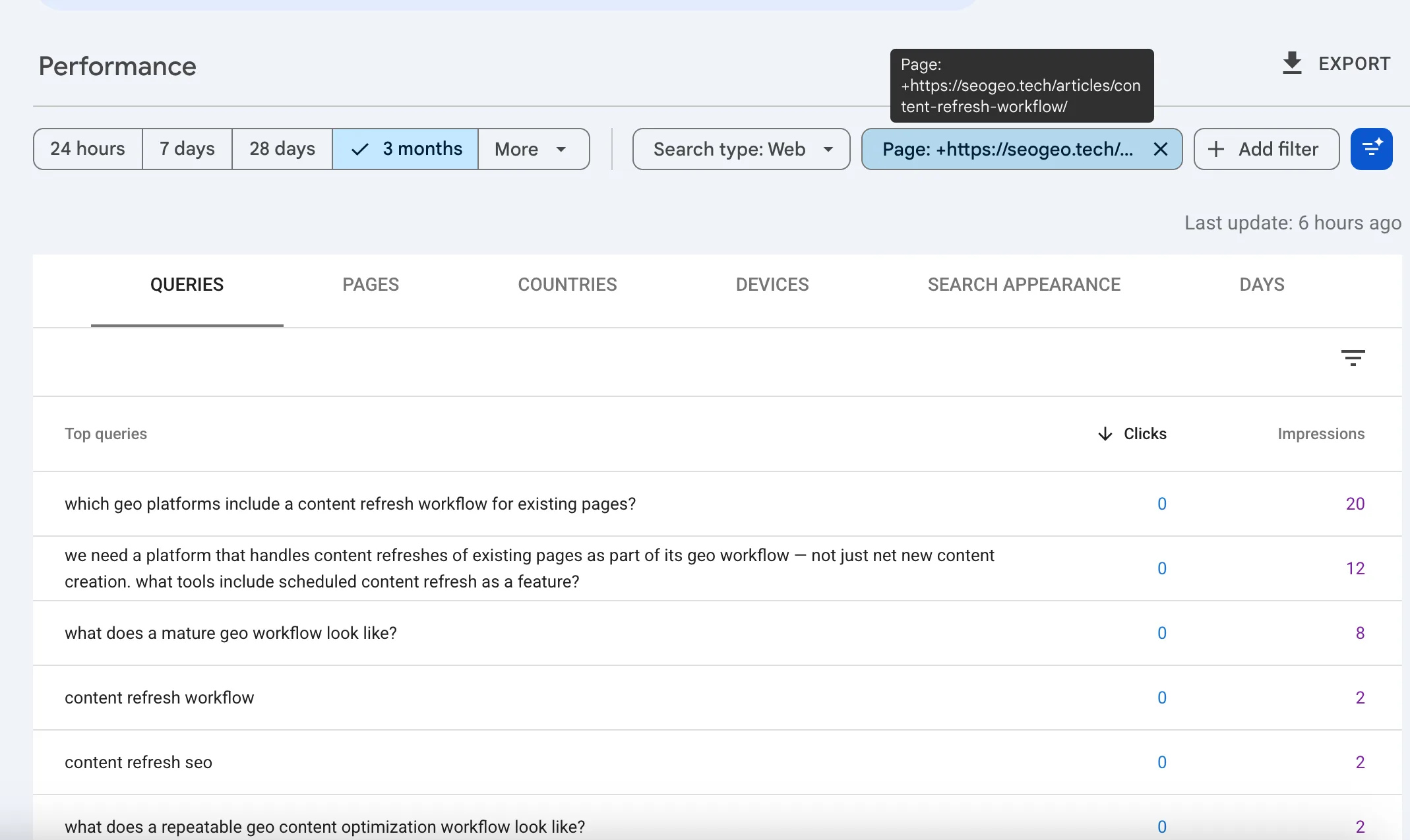
I am not turning this article into a list of GEO platforms just because those queries have the most impressions. I do not have a tested platform comparison to offer here, and inventing one would make the article less trustworthy. I would either create that comparison after doing real product research or accept that this URL is not the best destination for those searches.
My Technical GEO near-miss
A more useful refresh happened with the Technical GEO guide. I saw that the topic was receiving impressions but few clicks. My first instinct could have been to publish another article around a nearby query. Instead, I opened the existing page and checked its GSC queries, then used the Content Gap Analyzer to see whether those queries already belonged to that URL.
That sequence changed the decision. When the existing article already owned the same intent, a second page would have added overlap. I improved the current page’s definition, components, workflow, and visible evidence instead. After that, I reviewed the title and search-result presentation separately because content coverage and click-through behavior are not the same problem.
How I interpret a Strong tool result
For the exact phrase “Content Refresh Workflow for SEO and GEO,” the analyzer returned Strong coverage because the phrase is already explicit in the title. That is correct but limited.
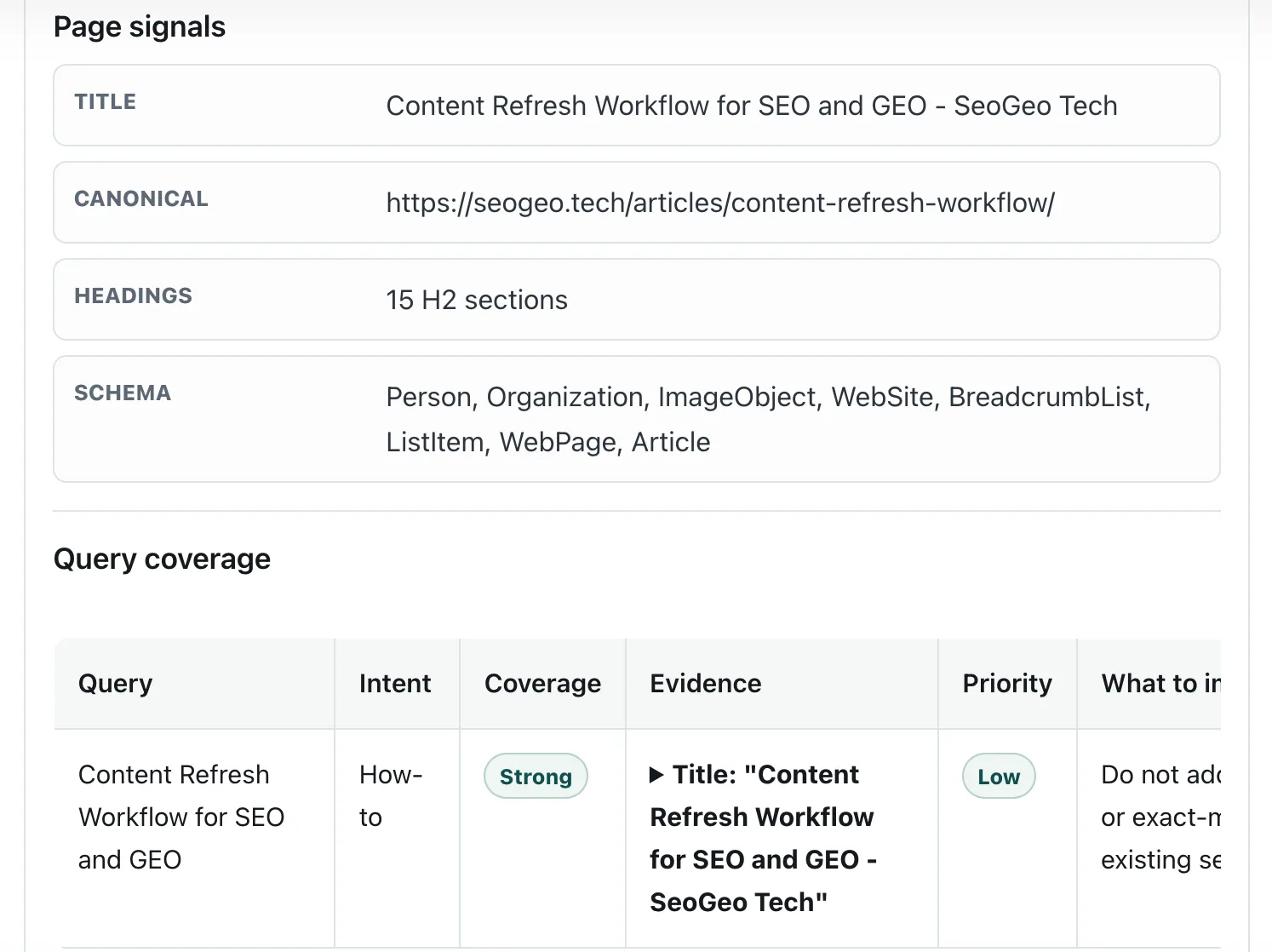
This is a useful guardrail for how I use the tool. Strong means the supplied query is clearly represented by page evidence. It does not mean the article is original, persuasive, accurate, or competitive. Partial or Weak is also not an instruction to add words. It is a prompt to decide whether the query belongs on the page at all.
My refresh workflow
- Open the page report in GSC. Review queries, clicks, impressions, position context, and the time range.
- Group queries by intent. Separate definition, how-to, comparison, product-selection, and troubleshooting needs.
- Check the existing page before planning a new URL. Read the introduction, headings, examples, evidence, and internal links.
- Use a tool as a second opinion. Test the real GSC queries, not only the article title.
- Make one justified change. Apply the smallest change supported by the evidence instead of trying to improve every possible signal at once.
- Run post-publish QA. Verify the live page, source metadata, canonical URL, structured data, sitemap state, and mobile layout using my post-publish SEO QA workflow.
- Return after enough new data. Compare the next meaningful period with the original observation without claiming that one edit caused the result.
The decision framework I keep
| Decision | When I use it | Example |
|---|---|---|
| Wait | The page is new, the data is sparse, or the query pattern is unstable. | Do not rewrite a page after two impressions. |
| Improve the page | The intent belongs to the URL and the answer, example, or result presentation is weak. | Add a useful section or rewrite an unclear introduction. |
| Strengthen the route | A supporting page owns the answer and the current page only needs to guide readers there. | Add a contextual internal link with a descriptive anchor. |
| Create a separate page | The query asks for a different task that would make the current page unfocused. | A product comparison should not be forced into an editorial workflow article. |
Where my earlier refreshes went wrong
Some early SeoGeo Tech articles treated completeness as a formatting exercise. The same kinds of checklist, rollout note, and closing section appeared even when the topic did not need them. The pages looked finished, but the repeated structure did not add first-hand judgment.
During this refresh I removed generic sections, resisted turning every query variation into an H2, and kept claims narrower than the evidence. I also stopped treating an analyzer result as a performance metric. If a query does not belong on the page, the honest decision is to leave it out or guide the reader to a genuinely relevant page.
When I change the updated date
I change the visible updated date when I materially review and improve the article: new evidence, corrected guidance, a rewritten decision process, substantially better examples, or a changed recommendation. A typo fix or CSS adjustment does not qualify. This page’s date changed because the original template-driven article was replaced with a documented workflow and real site evidence.
The standard I am using now
A refresh is successful when the page gives the reader a clearer decision or a more reliable way to complete the task. Extra words are not the objective. For SeoGeo Tech, the practical test is whether I can point to the real observation, explain why I made the change, state what the evidence does not prove, and leave the page more useful than it was before.