

SEO
A SeoGeo Tech case study exploring why Google surfaced three article headings as sitelinks, and what that suggests about page structure, search navigation, and Technical GEO.
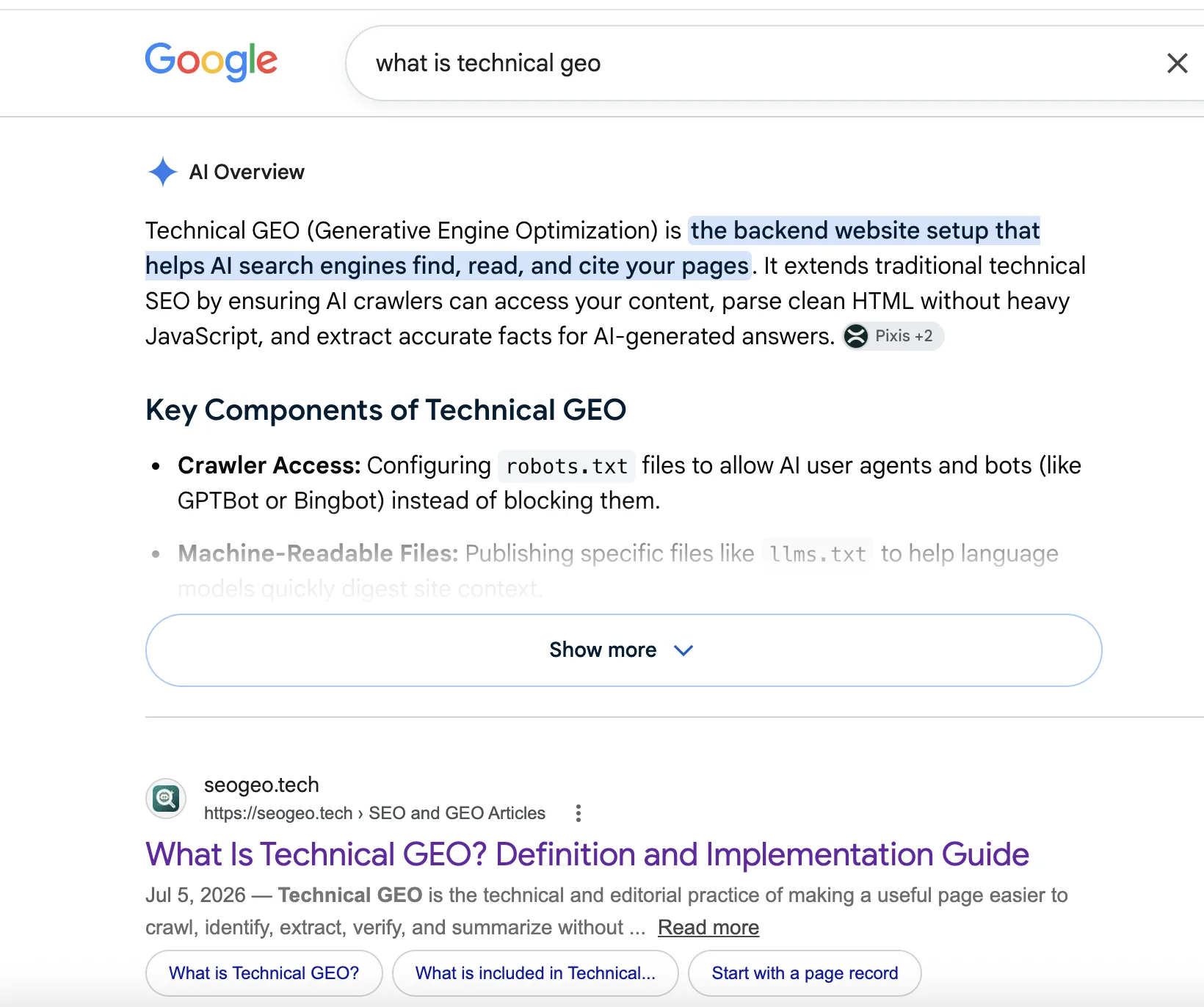
I wanted to answer one question: why these three?
Google surfaced a definition, a scope section, and a starting point. Not the canonical section. Not structured data. Not the QA checklist. That immediately made me wonder why.
I am not claiming that I can control these links. I am also not treating the screenshot as ranking proof or AI citation proof. This is a case study about page structure: how headings, anchors, and section-level intent can make a technical article easier to navigate.
Understanding These Sitelinks
Google officially refers to these as sitelinks, which can point to other pages, headings, or anchors within the same page. In Google’s documentation, they are still treated as sitelinks even when they point to headings within a page. Here, they point to section-level anchors within my article.
That matters because it keeps the goal honest. I did not manually add these links to Google, and I cannot force them to appear. The goal is not to “get three buttons.” The goal is to build pages where important sections are clear enough that users, crawlers, and search systems can understand what each section is for.
Why Google Surfaced These Three Sections
I cannot know Google’s exact internal reason for surfacing these links. But looking at the query, the page, and the visible headings, the selection made sense.
| Section Google surfaced | Likely job for the searcher | Why it fits the query |
|---|---|---|
What is Technical GEO? |
Definition | The query itself is what is technical geo, so a direct definition section is the most obvious shortcut. |
What is included in Technical GEO? |
Scope and components | After a definition, the next natural question is what the practice includes: HTML, canonical signals, structured data, links, evidence, and checks. |
Start with a page record |
First implementation step | This section turns the concept into an action. It gives readers a starting point instead of another abstract explanation. |
That pattern is what caught my attention. The three surfaced links are not random technical details. They form a small path: definition, components, first action. For a broad informational query, that is a useful navigation sequence.
Interestingly, Google did not surface the most technical sections on the page. Instead, it surfaced the sections that establish context first. That reinforces my view that broad navigational value may matter more than technical depth for broad informational queries.
Why not the other headings?
The page contains many more valid H2 sections than the three Google surfaced. But not every heading is equally useful as a search result shortcut for this query.
For example, sections like Align canonical metadata with the visible page or Add structured data without hiding facts are useful once a reader is already doing the work. They are narrower. They fit someone who already understands Technical GEO and wants a specific implementation detail.
For the query what is technical geo, Google may prefer broader sections that help a reader orient themselves first. That is my working interpretation:
- Broad sections are better shortcuts for broad queries. Definition and component sections make more sense than deep implementation details.
- Compact headings are easier to reuse.
What is Technical GEO?is clearer as a shortcut than a long, specialized heading. - Early sections may carry more navigational value. The surfaced links point readers to the start of the page’s explanation path.
- Different queries could surface different links. A query about canonical metadata might not need the same three shortcuts.
This is also why I do not rewrite a page every time I see a SERP variation. One logged-in desktop result is an observation, not a universal rule. But it is still useful evidence for how the page is being presented.
The page structure behind the result
On the Technical GEO implementation guide itself, those links correspond to visible sections in the page outline. The page has an “On this page” table of contents, and each item points to a real section in the article body.
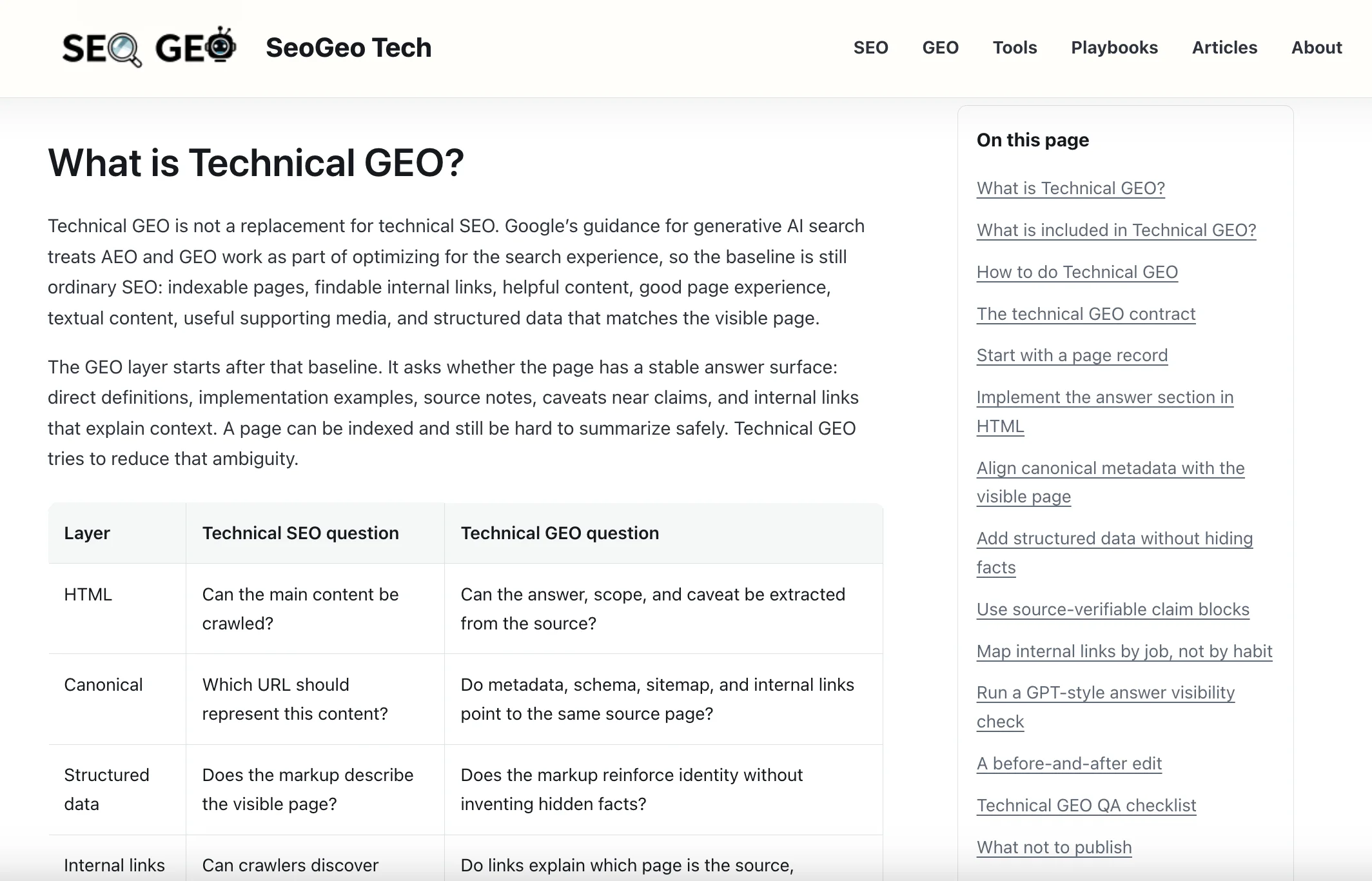
This is the part I care about for Technical GEO. A page should not only have a good title. It should have sections that behave like independent answer surfaces. A reader should be able to jump into a section and understand the local job of that section without needing to reread the whole page.
That is why I pay attention to headings when I edit SeoGeo Tech articles. I want a heading to describe a useful reader task, not just decorate the page. If a heading is vague, clever, or repeated, it may still look fine to a human skimming the article, but it is less useful as a navigation label.
What Google recommends for sitelinks quality
Google says sitelinks are automated, but it gives several quality recommendations that map directly to page structure. The advice is simple: use page titles and headings that are informative, relevant, and compact; create a logical structure; use concise and relevant internal anchor text; and avoid repetition.
That lines up with what I saw on SeoGeo Tech. The surfaced sections were not clever slogans. They were plain-language headings that matched common reader tasks:
- Definition: What is this?
- Scope: What does it include?
- Action: Where do I start?
This does not mean every heading should be a keyword. It means the page outline should be useful even when separated from the full article.
What weak headings look like
The easiest way to see the difference is to compare vague headings with task-based headings. Vague headings may look normal inside an article, but they are weak navigation labels once separated from the surrounding text.
| Weak heading | Why it is weak | Better heading |
|---|---|---|
Overview | It does not say what the section explains. | What is Technical GEO? |
Details | It is too generic to be useful as a shortcut. | What is included in Technical GEO? |
Implementation | It hints at action but does not say where to begin. | Start with a page record |
More tips | It sounds like leftover content, not a clear reader task. | How to do Technical GEO |
None of the weak examples are technically wrong. They simply do less work when separated from the page.
This is why I try to avoid decorative headings on SeoGeo Tech. A heading should describe the job of the section. If the heading cannot survive outside the article, it probably needs to be clearer. When I need a practical reminder, I go back to my GEO content structure and formatting test: answer first, make scope visible, and keep caveats close to the claim.
Why this matters for AI Search and Technical GEO
This screenshot also reminded me that Google increasingly understands documents as collections of answerable sections rather than one long page. Whether the retrieval system is classic Search, AI Overviews, or another AI-assisted experience, section-level understanding is becoming increasingly important. It is the same reason my query fan-out SEO workflow starts by mapping one broad query to several section-level information needs.
Google’s ranking systems guide describes passage ranking as an AI system used to identify individual sections or “passages” of a web page to better understand relevance for a search.
That matters for Technical GEO. AI and search systems do not always need the entire article in sequence. A system may retrieve or evaluate a relevant section, paragraph, or answer block. If that section has a clear heading, direct answer, nearby caveat, and supporting context, it is easier to understand without dragging the whole page along with it.
This is also consistent with Google’s AI Search guidance: AI Overviews and AI Mode still rely on ordinary SEO fundamentals, including crawlable pages, internal links, useful textual content, and structured data that matches the visible page. There is no special shortcut here. The practical work is still page quality, but page quality now has a stronger section-level dimension.
My heading test after seeing this
After this screenshot, I started using a small test when reviewing article outlines. I ask whether each important H2 could stand alone as a useful shortcut.
| Question I ask | What I look for |
|---|---|
| Does the heading match a real reader question? | A section should answer a task like definition, comparison, workflow, evidence, or next step. |
| Is the heading compact? | If the heading is too long, it may be hard to use as navigation. |
| Does the first paragraph deliver on the heading? | The section should answer quickly before expanding into details. |
| Is the section distinct from nearby headings? | Repeated or overlapping headings weaken the page outline. |
| Does the anchor make sense out of context? | A reader jumping from search should know where they landed. |
This is also where my SEO and GEO thinking meet. Classic SEO cares whether Google can crawl, index, and understand the page. Technical GEO adds another layer: can the page be broken into stable, extractable sections without losing the meaning?
What I would not do
A screenshot like this can tempt people to over-optimize. I am deliberately not doing that.
- I would not add duplicate headings just to chase more sitelinks.
- I would not stuff every H2 with exact-match query wording.
- I would not change the existing Technical GEO article just because one desktop SERP showed three shortcuts.
- I would not claim these links prove ranking strength, AI Overview inclusion, or AI citation quality.
The safer takeaway is smaller and more useful: if Google may surface headings as search result navigation, then headings deserve the same editorial care as titles and descriptions.
How I will use this on future articles
For new SeoGeo Tech articles, I will keep using a simple section order when the topic is broad:
- Definition: explain the concept clearly.
- Scope: list what is included and what is not.
- Workflow: show how I would actually apply it.
- Evidence: include screenshots, source notes, or validation steps when available.
- Limits: explain what the page does not prove.
That structure is not only for Google. It is for readers. If the page is useful as a document, it has a better chance of being useful as a search result.
Conclusion
I do not think the lesson is to chase section links. The lesson is to write sections that deserve to become navigation.
I cannot control which headings Google surfaces. I can control whether every heading is worth surfacing.
The better question was: “If Google had to surface three shortcuts from this page, which sections deserve to be shortcuts?”
That question is now part of how I edit SeoGeo Tech articles. A good heading is not just a label inside the page. Sometimes, it becomes the entry point for a searcher, a crawler, or an AI-assisted search experience.