

GEO
Learn how query fan-out can improve AI search content by mapping related queries, content gaps, and existing pages.

I used to treat a Search Console query as a single content idea. If I saw how to do technical geo, my first instinct was to turn it into a new article. That feels productive, especially on a young site where every new URL looks like progress.
But AI search made me slow down. Google says AI Overviews and AI Mode may use a query fan-out technique: a system can issue multiple related searches across subtopics and data sources to develop a response. In plain English, one user question can turn into several hidden follow-up searches.
That changed how I plan content for SeoGeo Tech. I no longer ask only, “What is the exact query?” I ask, “What other questions might this query expand into, and can my page answer them without becoming messy?”
This article is my practical query fan-out SEO workflow. It is not a promise that a page will appear in AI Overviews, AI Mode, or any AI answer. It is a way to make a page more complete, less fragmented, and easier to evaluate before I create another overlapping article.
What query fan-out means for SEO
Query fan-out means a search system may break a broad or complex question into related sub-questions. Google gives examples in its generative AI search guidance: one query can lead to related queries that gather more information before a response is assembled.
For SEO work, I translate that into a simple editorial question:
Query fan-out SEO is the practice of checking whether a page covers the important sub-questions behind a search topic: definition, components, process, examples, limitations, comparisons, and next steps.
This does not mean stuffing a page with every possible keyword variation. It also does not mean creating five nearly identical articles for five related queries. The useful part is the mapping step: which related questions belong on the same page, and which ones deserve a separate URL?
Query Fan-Out Is More Than Keyword Clustering
Keyword clustering groups similar phrases. Query fan-out thinking is a little different. It asks what information needs may sit behind a broad question, even when the exact words are not visible in a keyword export.
For example, a user might ask an AI search system, “How should I optimize a technical SEO article for AI search?” That question could require several supporting needs:
- What makes content accessible to AI search systems?
- How should the page structure direct answers?
- Does structured data help, and where can it become misleading?
- How should claims, sources, and limitations be presented?
- What technical SEO issues can prevent retrieval or extraction?
- How can AI search visibility be checked without overclaiming results?
I can then map those information needs to existing sections, supporting pages, or genuine content gaps. That is why I treat query fan-out as an information architecture exercise, not only a keyword grouping exercise. The goal is to make the page satisfy the surrounding information need without turning it into a pile of repeated keyword variants.
Why this matters for SeoGeo Tech
SeoGeo Tech is a small site about SEO, GEO, AI search, structured data, metadata, and technical publishing. That makes topical clarity important. If I publish too many overlapping pages, the site starts to look busy but less coherent.
The clearest example is the Technical GEO cluster. Search Console showed several related queries around one topic:
technical geowhat is technical geowhat is included in technical geohow to do technical geotechnical geo elements
At first glance, each phrase could become a title. That is exactly the trap. A definition query, a component query, and a how-to query are different enough to require clear sections, but not always different enough to require separate articles.
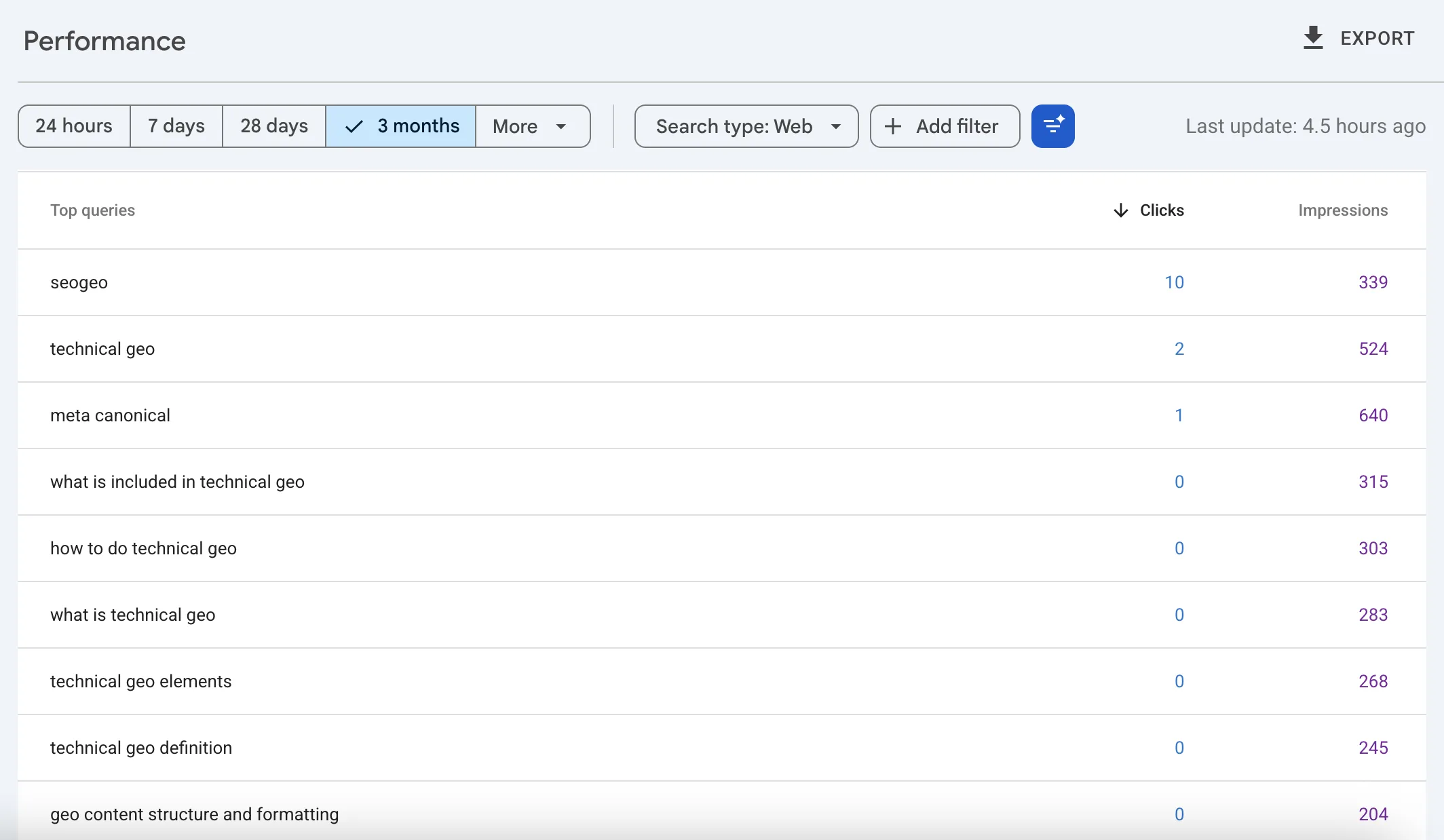
Search Console queries are not Google’s actual query fan-out queries. I cannot see the internal queries Google may generate for AI Overviews or AI Mode. I use my visible GSC queries as a practical proxy: a planning signal that helps me think through related information needs on my own pages.
My query fan-out workflow
When I see a query cluster like this, I use a small workflow before writing anything new.
- Choose the seed query. I start with the main phrase that represents the topic, such as
technical geo. - List the fan-out questions. I group related queries by the job they ask the page to perform.
- Check the URL Google already associates with the query. If Search Console points to an existing page, I inspect that page first.
- Map each query to a visible section. A strong page should not make readers hunt for the answer.
- Decide whether to improve, split, or wait. A new article is the last option, not the first reflex.
The important word is visible. If the answer only exists in my head, in schema, or across three other articles, I do not count that as strong coverage. A reader should be able to land on the page and find the answer in normal HTML.
How I group fan-out queries
I usually group related queries by intent, not by exact wording. Here is how I mapped the Technical GEO examples on SeoGeo Tech.
| Query type | Example query | What the page should provide |
|---|---|---|
| Core topic | technical geo | A clear explanation of the concept and why it matters. |
| Definition | what is technical geo | A direct definition near the top of the page. |
| Components | what is included in technical geo | A scannable list or table of elements. |
| How-to | how to do technical geo | A practical workflow with steps and checks. |
| Elements | technical geo elements | A component explanation that does not duplicate the definition. |
This is where query fan-out becomes useful. It reminds me that a good source page often needs several answer surfaces: a definition, a table, a workflow, a limitation, and internal links to deeper supporting pages.
I check the existing page before writing a new one
For what is included in technical geo, I filtered the query in Search Console and checked the Pages tab. The query pointed to the existing Technical GEO implementation guide. That was my signal to inspect the current page before creating anything new.
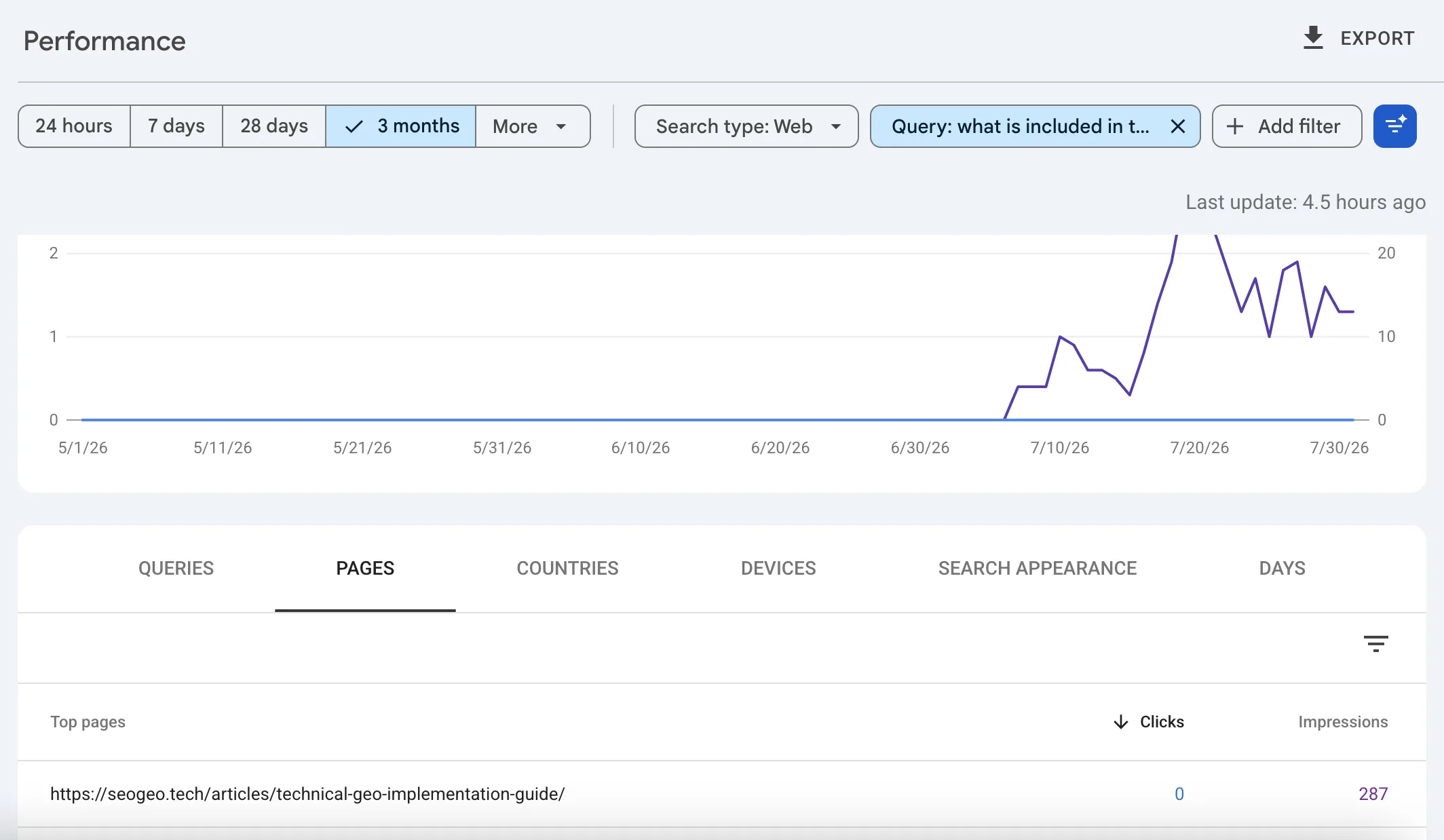
This step protects me from a common mistake: writing a new article because a query looks like a nice title. If the existing page already owns the topic, a second article may create overlap instead of value.
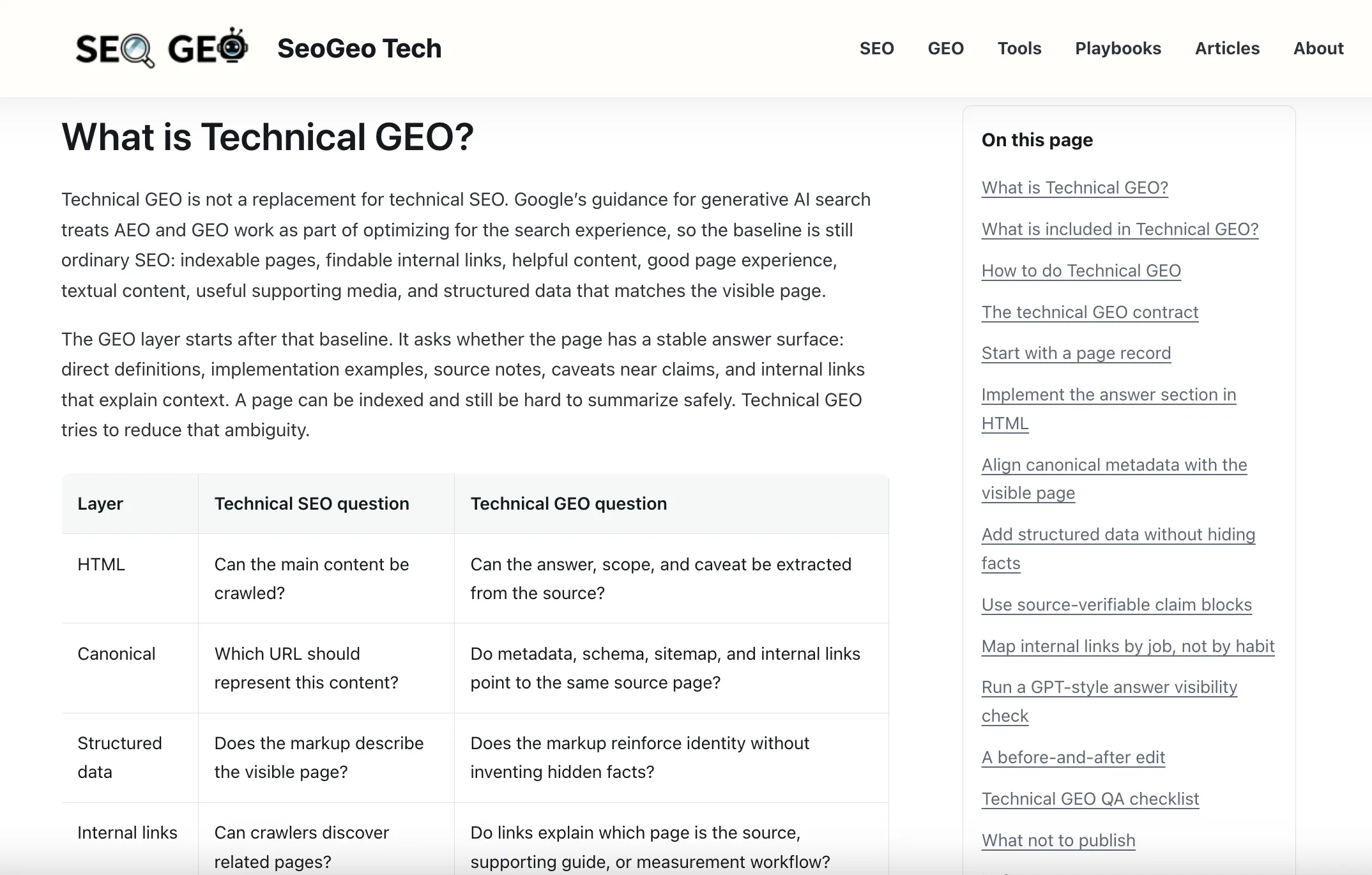
So I opened the page like a reader. I checked whether it had a direct definition, a components section, and a how-to workflow. In this case, the page already had the key sections: What is Technical GEO?, What is included in Technical GEO?, and How to do Technical GEO.
Where my content gap analyzer fits
I also use my AI Search Content Gap Analyzer as a second opinion. I paste the existing page URL and the related Search Console queries, then check whether the page appears to cover each query directly.
The tool does not make the decision for me. It does not measure rankings, AI Overview inclusion, AI Mode visibility, or AI citations. It simply helps me compare a page against real query wording and look for weak or missing sections.
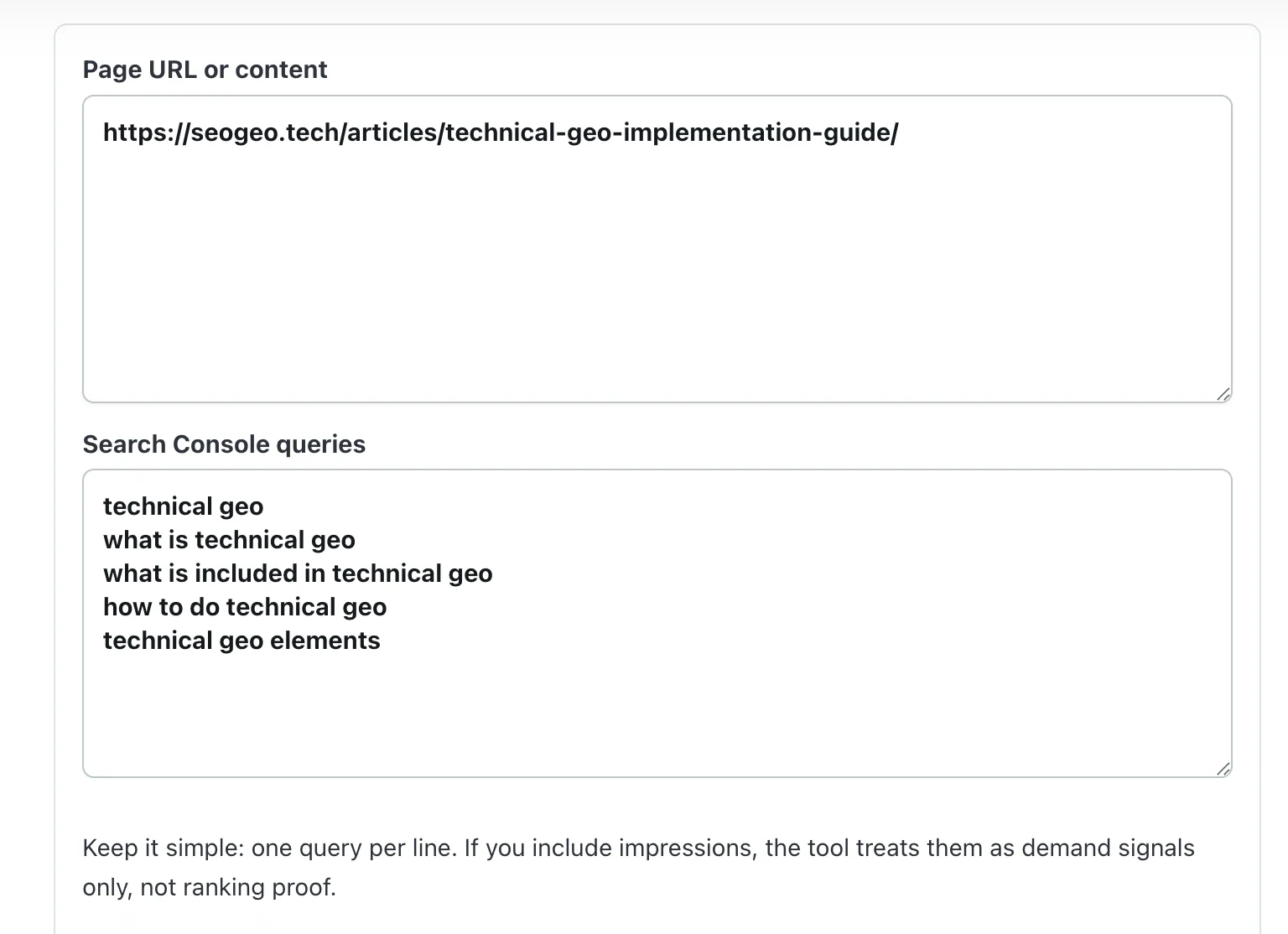
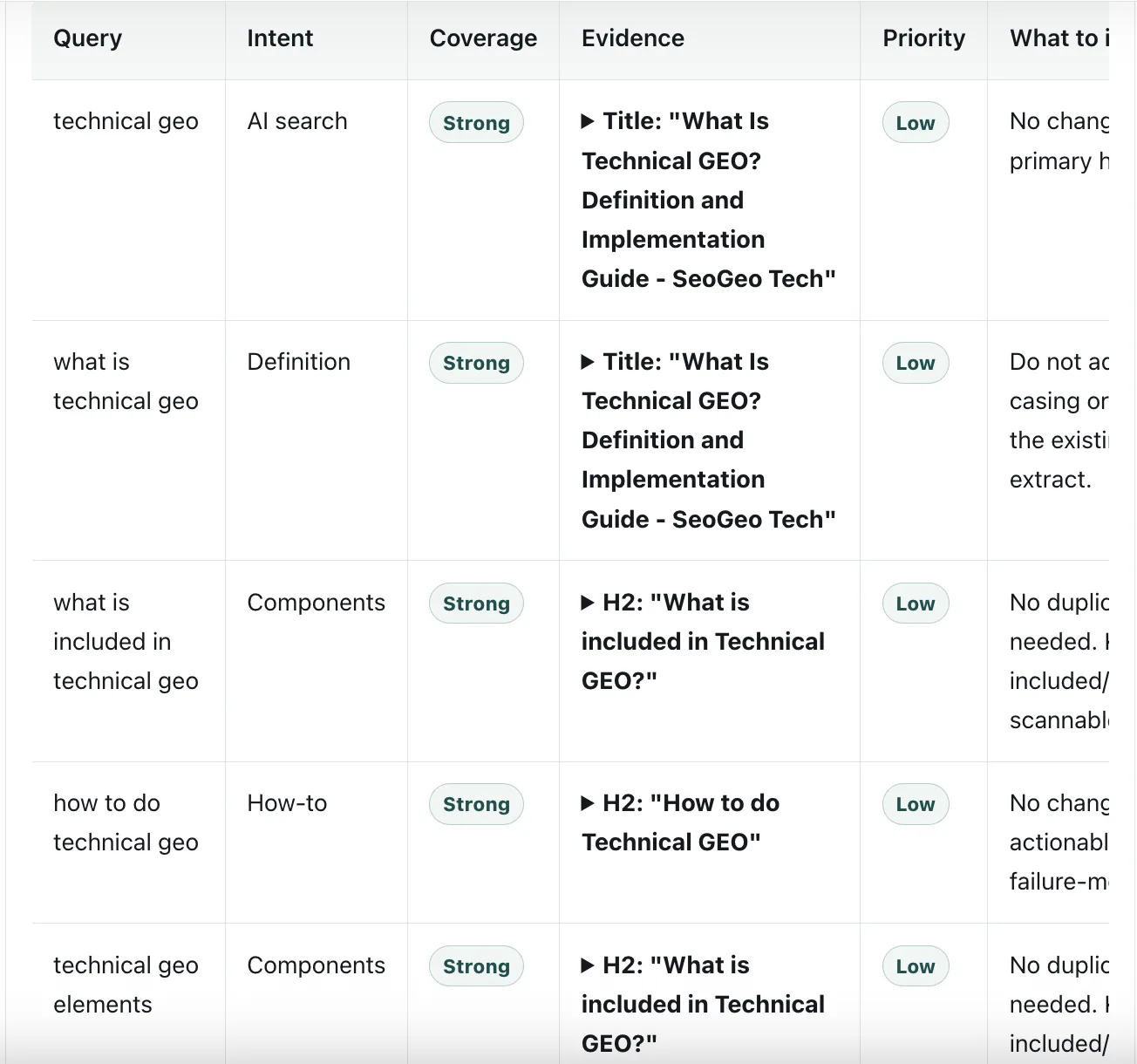
When the analyzer says a query is strong and points to a visible section, I usually avoid adding another article. When it says coverage is partial and the evidence is weak, I check whether a new section would help. Only when the intent is genuinely different do I plan a separate URL.
A small before-and-after example
Here is the kind of edit I want query fan-out analysis to produce. The result should be a cleaner page plan, not a longer article by default.
| Before checking fan-out needs | After checking fan-out needs |
|---|---|
The page explains Technical GEO generally. | Add or keep a direct What is Technical GEO? section near the top. |
| Components are mentioned across several paragraphs. | Use one components table for what is included and elements queries. |
| The implementation advice is buried in narrative text. | Keep a visible How to do Technical GEO workflow. |
| Formatting tests and answer extraction are repeated in full. | Use internal links to the GEO content formatting test and answer extraction testing guides. |
| A separate article is created for every wording variation. | Create a new URL only when the reader task is different, such as a case study, tool, or checklist. |
My decision table
This is the table I use when a query fan-out cluster appears in Search Console.
| Signal | What I usually do | Why |
|---|---|---|
| Several related queries point to one strong page | Improve the current page | The page is already the source page for the topic. |
| A query has a different reader task | Consider a new article | A comparison, checklist, case study, or tool may need its own URL. |
| The existing page has no visible answer | Add or revise a section first | A missing H2 is often easier to fix than a weak new article. |
| The topic would make the page too broad | Split carefully and link both pages | Good fan-out coverage should not turn one page into a dumping ground. |
| The data is too early or unclear | Wait and monitor | Not every impression spike needs an immediate content change. |
What I avoid
Query fan-out can be misused. If I treat it as a keyword expansion trick, the page gets worse. These are the mistakes I try to avoid on SeoGeo Tech:
- I do not create one article per query variation. That can fragment a topic cluster.
- I do not add duplicate H2 headings just for exact-match wording. A clear components section can cover several related component queries.
- I do not hide important answers only in schema. The answer should be visible in the page body.
- I do not treat impressions as proof of ranking quality. Impressions are useful demand signals, not success certificates.
- I do not claim query fan-out optimization guarantees AI citations. It is a content planning method, not a control panel for AI search.
Query Fan-Out SEO checklist
Before I optimize a page for a query fan-out cluster, I run this checklist:
- Pick one seed query from Search Console or topic research.
- List related definition, component, how-to, comparison, and limitation questions.
- Check which existing page Google already associates with the query.
- Map each important query to a visible title, H2, table, paragraph, or example.
- Improve the existing page before creating a new URL.
- Create a new article only when the reader task is clearly different.
- Add internal links from the source page to deeper supporting guides.
- Keep caveats close to claims, especially for AI search and GEO advice.
- Recheck the live page after publishing or updating.
FAQ
Does query fan-out optimization guarantee AI Overview visibility?
No. A page still needs to be indexed, useful, technically accessible, and eligible for Google Search features. Even then, visibility in AI features is not guaranteed.
Should every fan-out query become an H2?
No. Some queries deserve a heading, some fit inside a table, and some are better handled through internal links. The goal is useful coverage, not heading inflation.
When should I create a separate article?
I create a separate article when the reader task changes enough that the current page would become confusing. For example, a broad definition page and a detailed case study usually deserve different URLs.
Conclusion
Query fan-out SEO changed how I think about content planning on SeoGeo Tech. I still care about individual queries, but I no longer treat each query as an automatic article idea.
Now I ask a better question: if AI search or a reader expands this topic into related sub-questions, does my page answer them clearly enough?
Sometimes the answer is a new article. More often, the answer is a better section, a clearer table, a stronger example, or a more useful internal link. That is quieter work, but it makes the site cleaner.