

GEO
One real Search Console screenshot shows why captions, visible values, and separately supplied information need to stay distinct.
A screenshot can be genuine while the sentence beside it is wrong. On SeoGeo Tech, one saved Search Console image makes that distinction unusually clear: it shows page-level impression counts, but not the site-wide total.
The question here is how to publish that image without asking it to prove more than it contains. This is an evidence-editing problem, not a way to make an image earn AI citations.
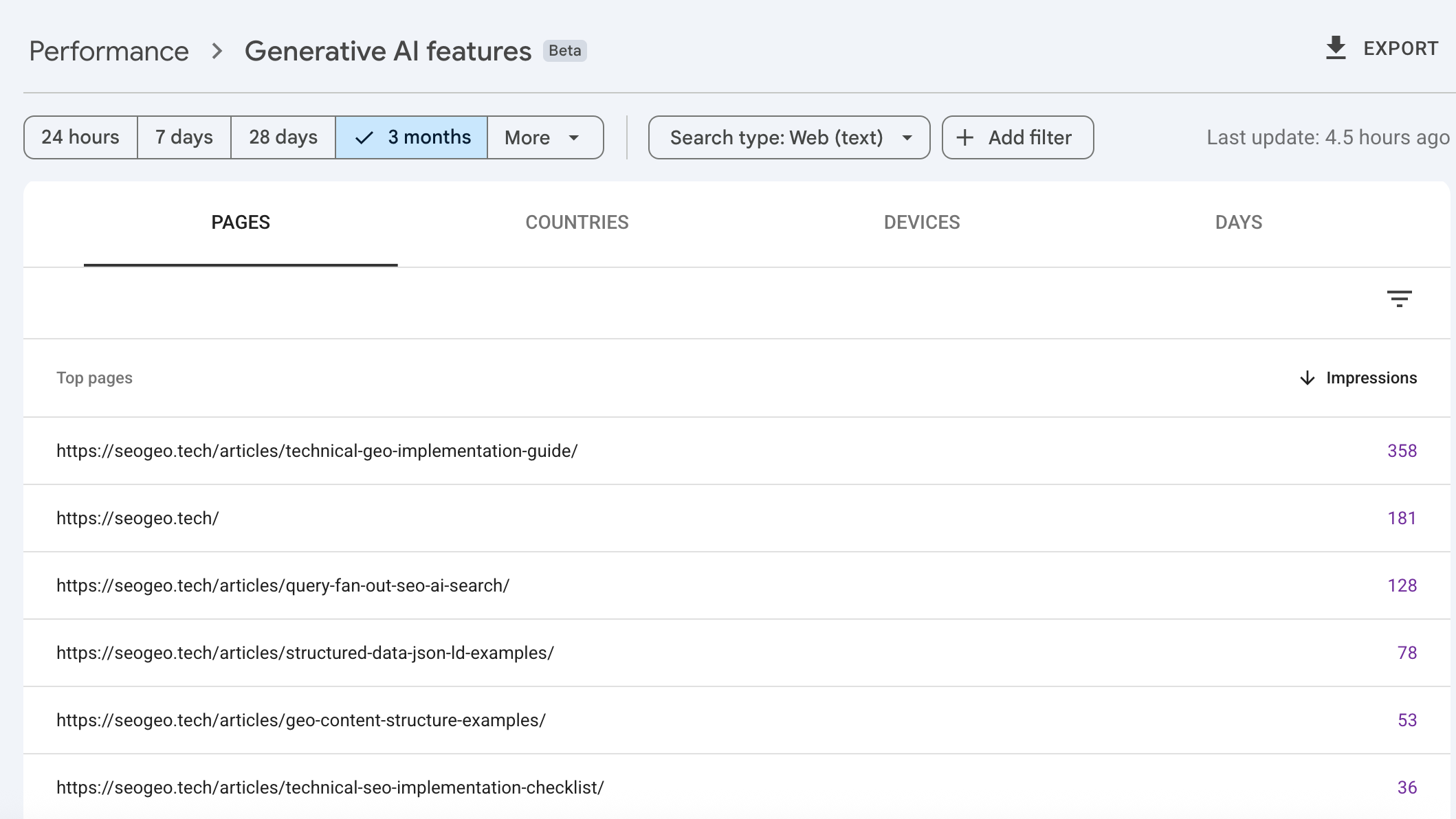
The number that is not in this image
The visible rows show 358 impressions for the Technical GEO guide, 181 for the homepage, 128 for Query Fan-Out, 78 for the structured-data article, 53 for Content Structure Examples, and 36 for the technical SEO checklist. The report header and selected filters belong to the evidence too: without them, those numbers would have much less context.
The separately recorded figure of 1,261 is not visible in this screenshot. The six visible page rows add up to 834. I cannot reconcile the difference from this image alone. The screenshot shows only part of the page list, and Search Console can also report different totals at property and page level. I therefore do not use this image as evidence for the 1,261 figure. If I include that total, I need to identify its source and confirm that its report, filters, and date range match the screenshot.
The AI visibility measurement article discusses the metric; this article focuses on a narrower question: whether the screenshot itself supports the accompanying claim.
The date also needs careful handling. “Captured on September 27” describes when the image was saved. It does not mean these impressions happened on September 27. The selected range is three months, and the exact start and end dates are not displayed.
A caption should survive being read without the article
Consider this proposed caption: “Our GEO changes increased AI visibility.” Nothing in this still image establishes that. It contains no before-and-after comparison and no record linking an edit to an outcome. Adding the word “proof” would only make the mismatch worse.
A useful caption identifies the report, scope, and relevant observation. It can be plain: “The Technical GEO guide has 358 impressions in this saved three-month Pages view.” That sentence is narrower, but a reader can verify it directly.
I keep the essential values in selectable text, rather than requiring readers to enlarge the image. The short alt text identifies the report and points to the transcription; it does not repeat every URL and number. W3C’s guidance for complex images describes this division: a short identification plus a text alternative containing the essential information. Nearby visible text is useful to readers who cannot see the image as well as those viewing a small screen.
The screenshot remains worth keeping because it lets readers check the report labels and the relationship between the rows. If I removed the image, though, the actual observations would still be available in the paragraph above.
A diagram is an explanation, not another screenshot
A diagram of “source page → retrieval → generated answer” would have a different role. Unless it came from recorded system traces, those arrows would describe a proposed model of the process—not evidence that a particular service followed that route or selected our page.
That difference belongs in the visible caption: “Conceptual diagram” is more informative than “GEO evidence.” If an arrow means a possible transition, label it that way. If the diagram omits intermediate steps, say what level of detail it represents. A short text explanation should carry the relationships so the labels inside the image are not the only account of the process.
A decorative dashboard illustration can introduce a topic, but it should not be presented as a report. Making an illustration look technical does not turn it into a measurement. Keep that distinction explicit wherever an illustration appears beside real evidence.
For this figure, the editing decision is small but consequential: preserve the report context, transcribe the visible counts, and keep the separately supplied total out of the caption. Layout fixes such as displaying the entire image are covered in Rendering Checks for SEO. A fully visible screenshot still needs an accurate explanation.