

Strategy
How I separate SEO problems from GEO problems on SeoGeo Tech, where the work overlaps, and what I check before changing a page.
I wrote this comparison because SEO is an established discipline while GEO is a newer label, and I kept seeing the two presented either as competitors or as the same thing. Neither view is useful to me. On SeoGeo Tech, I plan them separately but usually fix them on the same page.
My practical distinction: SEO is the foundation that helps a page become crawlable, indexable, discoverable, and useful in search. GEO is the additional work of making the page’s answer, evidence, entities, and limitations easier for generative systems to interpret and reuse accurately. GEO does not replace SEO.
What Search Console showed me
The first version of this article was already appearing for comparison intent. In the three-month screenshot below, queries included “how does seo differ from geo,” “difference between seo and geo,” and “how does geo differ from seo in practice.” The page had impressions but no clicks for the visible rows.
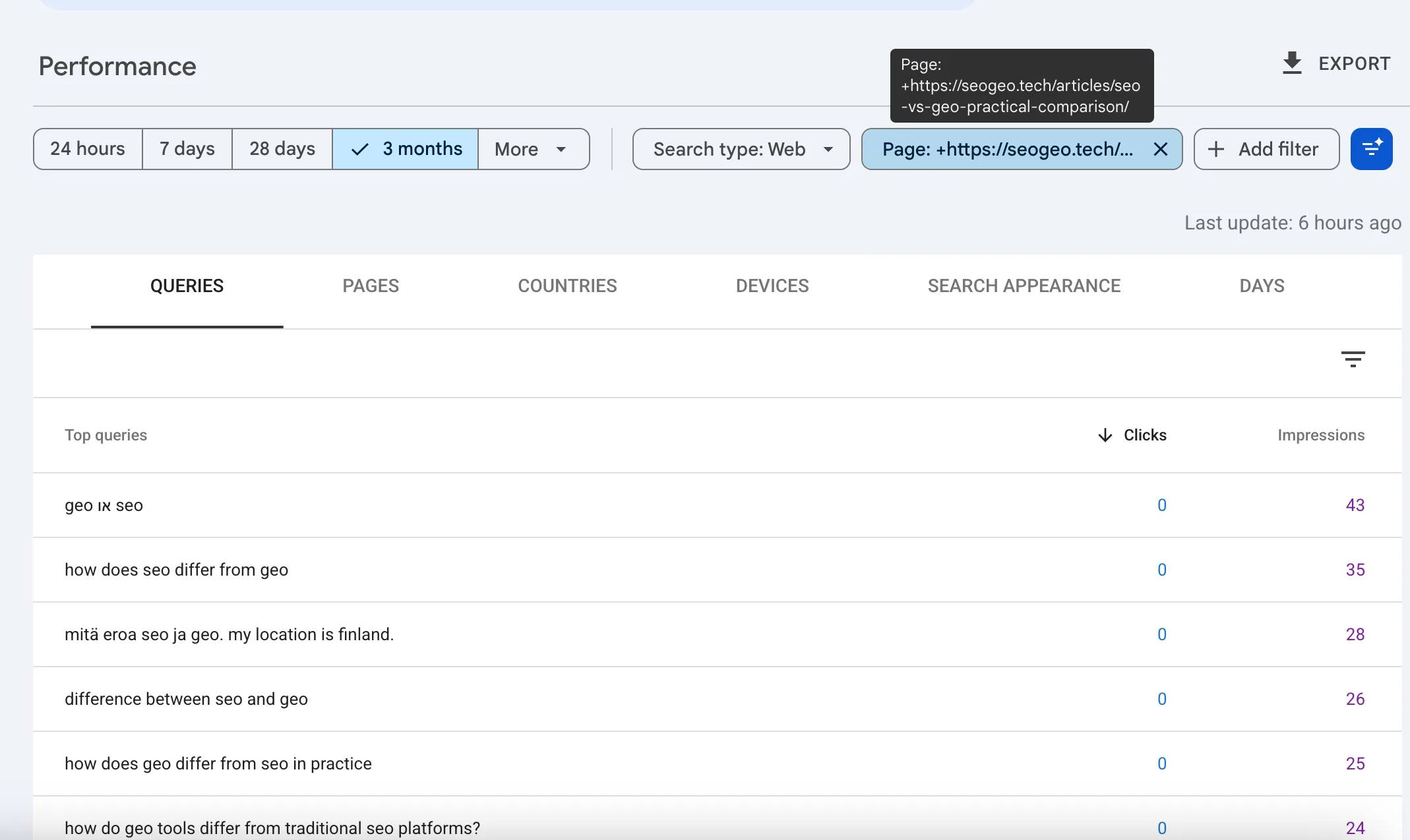
One visible query is “geo ιχ seo,” and another is in Finnish. I would not force either phrase into the copy. The useful pattern is the shared comparison intent. That is a better editorial signal than treating every raw query as a heading candidate.
The distinction I use when reviewing a page
This is not an industry-standard division of responsibilities. It is the distinction I use to avoid applying the wrong fix when I review one of my own pages.
| Area | SEO question | GEO question |
|---|---|---|
| Access | Can crawlers reach the page and its main content? | GEO depends on the same accessible source. |
| Page identity | Do the canonical URL, title, sitemap, internal links, and status code agree? | Does the answer system have one clear source page for the topic? |
| Intent | Does the page satisfy the search task behind its queries? | Can the main answer and follow-up information needs be understood section by section? |
| Evidence | Is the page original, accurate, and useful? | Can important claims be extracted with their source, scope, and caveat intact? |
| Measurement | Queries, impressions, clicks, positions, conversions, and page behavior. | AI visibility reports, repeatable prompt observations, citations, mentions, and summary accuracy—with clear limitations. |
How I decide which problem I am looking at
I start with the failure, not the label. If a page returns the wrong status code, has an inconsistent canonical, is missing from the site’s link structure, or does not expose the main content in usable HTML, I treat that as an SEO and technical publishing problem first.
If the page is accessible but the answer is vague, the important definition is buried, the evidence is separated from the claim, or a generated summary repeatedly loses a limitation, I treat that as a GEO and editorial-structure problem. Many real cases need both layers.
| What I observe | First review | Possible action |
|---|---|---|
| URL is not indexed or canonical signals conflict. | SEO / technical. | Check status, robots rules, canonical output, sitemap, and internal links. |
| Page has impressions but very few clicks. | Search intent and result presentation. | Review the mapped queries, position, title, snippet, and whether the right URL is appearing. |
| Page covers the topic but the answer is hard to quote accurately. | GEO / editorial structure. | Add a direct answer, nearby caveat, concrete example, or source-supported section. |
| AI Overview uses another source or summarizes the topic differently. | Observation, not diagnosis. | Compare evidence and page structure; do not assume one result proves a penalty or a permanent visibility gap. |
This page needs both kinds of review
This article itself is a useful example. Search Console shows that Google associates the URL with comparison queries, but the visible rows have impressions and no clicks. I treat that first as a search-performance question: Is the page appearing in a useful position? Does the title match the wording and intent? Is Google showing the right URL? The screenshot cannot answer those questions on its own.
The GEO question is different. If a generated answer reduces the article to “SEO is for search engines and GEO is for AI,” it loses the point I am trying to make: the two layers overlap, and the observed failure should determine which fix comes first. That is why the practical distinction and the diagnostic table matter more here than adding another general definition.
I also ran the broad query “SEO vs GEO” through the Content Gap Analyzer. It returned Strong because the comparison is explicit in the title and body. That confirms basic topic coverage, but it does not explain the zero-click GSC data.
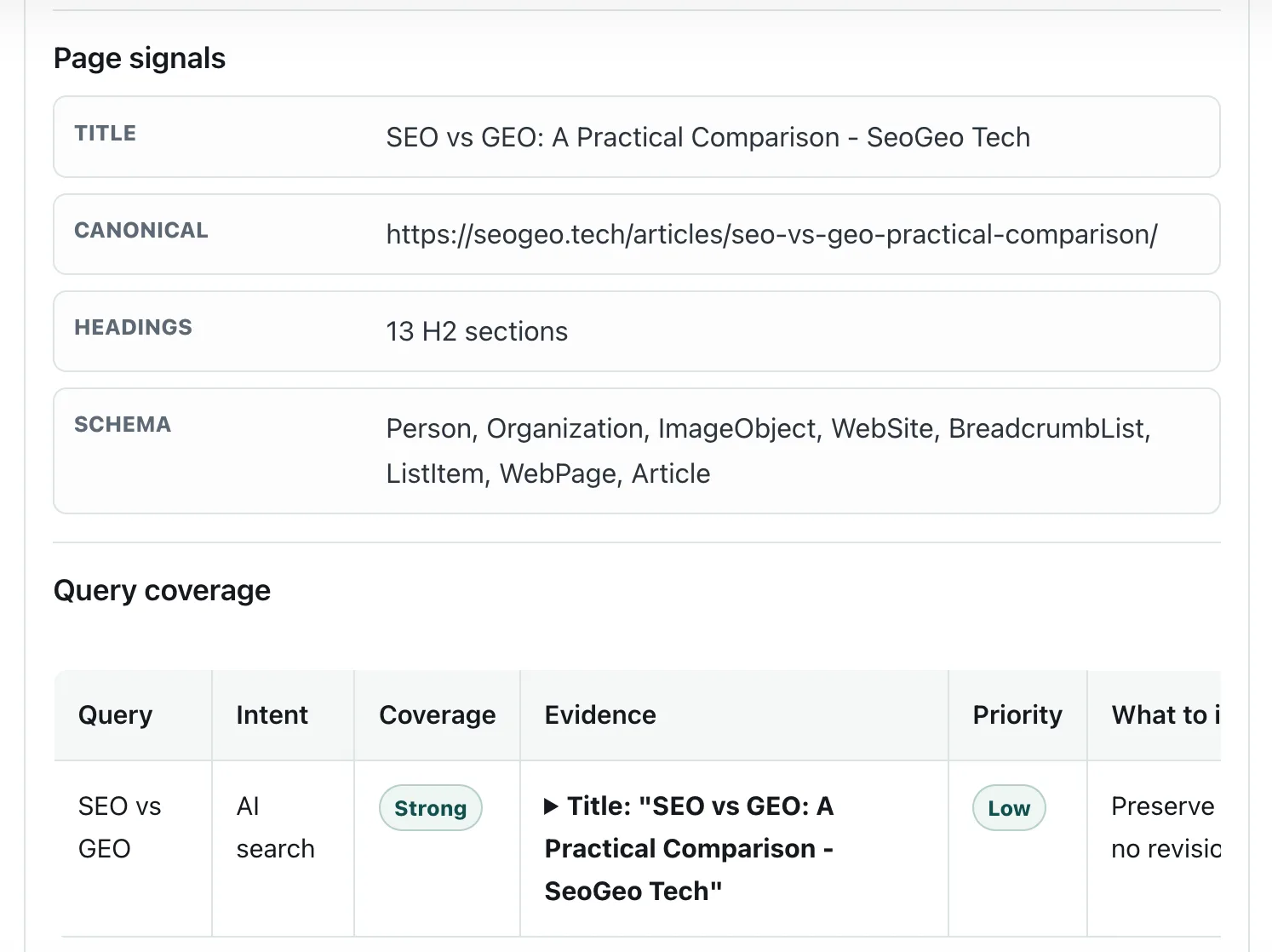
I keep the full process for deciding whether to wait, revise an existing page, strengthen an internal route, or publish something separate in my Content Refresh Workflow. Repeating that workflow here would distract from this article’s narrower job: deciding which kind of problem I am looking at.
What stays shared
Both SEO and GEO benefit from original information, clear writing, accurate claims, descriptive headings, useful internal links, and a site that is easy to navigate. A page does not become GEO-ready because it repeats “AI search.” It does not become SEO-ready because it has a title tag.
For the technical foundation, I use the Technical SEO implementation checklist. When the foundation is stable and the question becomes answer extraction, evidence, or source alignment, I use the Technical GEO implementation guide. The two workflows meet on the same published page.
Where I draw the line
SEO asks whether the right page can be discovered and presented for a search task. GEO asks whether the useful answer on that page can be interpreted and reused without losing its meaning. The work is different enough to name, but too connected to run as separate websites or competing strategies.