
GEO
Practical GEO page patterns with direct answers, summaries, evidence blocks, comparison tables, FAQ sections, source notes, and HTML examples.
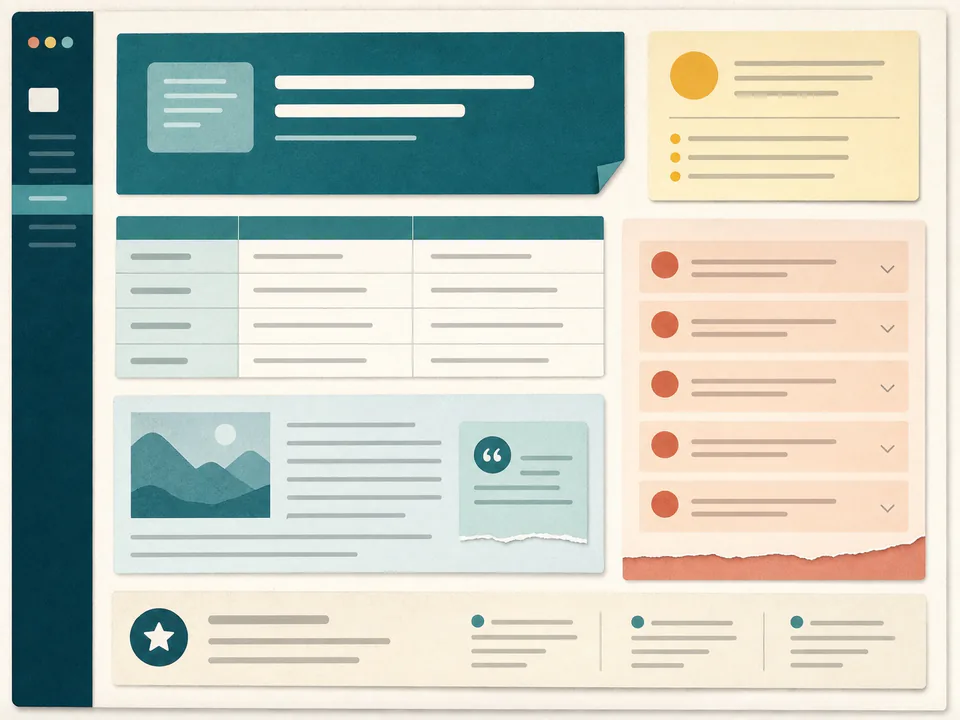
GEO content structure is about making useful meaning easier to extract. The best structures are simple: answer first, explain the context, show examples, state limitations, and link to supporting material.
Pattern 1: Direct answer block
Use this pattern when the page defines a concept or answers a specific question.
<section class="answer-block">
  <h2>What is a canonical URL?</h2>
  <p><strong>A canonical URL</strong> is the preferred URL for a piece of content when similar or duplicate versions exist.</p>
  <p>Use a canonical tag when users can access the same content through multiple URLs, such as tracking parameters or category paths.</p>
</section>
Pattern 2: Summary plus caveat
Answer engines can distort a recommendation if the limitation is far away. Keep the caveat close.
<div class="summary">
  <p>Use Article schema for editorial articles with visible headlines, dates, and author or publisher information.</p>
  <p>Do not use Article schema to describe product pages, empty category pages, or pages with no substantial editorial content.</p>
</div>
Pattern 3: Comparison table
Tables are useful when the reader needs a distinction. They also help extraction because the comparison is explicit.
| Use case | Canonical tag | Redirect |
|---|---|---|
| Duplicate URLs should remain accessible | Good fit | Usually not needed |
| Old URL is permanently replaced | Not enough | Good fit |
| Tracking parameters create duplicates | Good fit | Not practical |
| Two pages compete for the same intent | Temporary signal | Often consolidate and redirect |
Pattern 4: Evidence block
An evidence block explains why the recommendation exists. It can cite a source, show a command, describe a test, or connect the advice to observed behavior.
<aside class="evidence">
  <strong>Why this matters</strong>
  <p>The article body, title, canonical URL, and JSON-LD all identify the same page. That consistency reduces ambiguity for crawlers and answer systems.</p>
</aside>
Pattern 5: FAQ that earns its space
FAQ sections should answer real follow-up questions. They should not repeat the article title in different words.
<section aria-labelledby="faq">
  <h2 id="faq">FAQ</h2>
  <h3>Should every article have FAQ schema?</h3>
  <p>No. Add FAQ schema only when the page has a visible FAQ section with useful questions and answers.</p>
  <h3>Can structured data replace a weak article?</h3>
  <p>No. Structured data labels content. It does not create expertise, evidence, or originality.</p>
</section>
Pattern 6: Source-aware summary
For technical content, a source-aware summary is often better than a dramatic conclusion. It states what the page demonstrated and what the reader should verify in their own stack.
This guide shows a safe baseline for article metadata, canonical URLs, and Article JSON-LD. Before copying the snippets, update the domain, page title, dates, author or publisher, image URL, and canonical path to match your site.
Full article section template
The template below is intentionally plain. It works because it keeps the answer, conditions, examples, and validation close together.
<section aria-labelledby="canonical-answer">
  <h2 id="canonical-answer">When should you use a canonical tag?</h2>
  <p><strong>Use a canonical tag</strong> when similar URLs should remain accessible but one URL is the preferred version for indexing and consolidation.</p>
  <p>Use a redirect instead when the old URL should no longer be accessible to users.</p>
  <table>
    <thead><tr><th>Case</th><th>Use canonical?</th><th>Use redirect?</th></tr></thead>
    <tbody>
      <tr><td>Tracking parameters</td><td>Yes</td><td>Usually no</td></tr>
      <tr><td>Old article moved</td><td>No</td><td>Yes</td></tr>
    </tbody>
  </table>
</section>
Before and after outline
| Weak outline | Stronger GEO-ready outline |
|---|---|
| Intro about why the topic matters. | Direct answer in the first paragraph. |
| General benefits. | Specific use cases and non-use cases. |
| Long paragraph explaining everything. | Steps, table, example, limitation note. |
| Generic conclusion. | Validation checklist and related implementation links. |
Questions to answer before publishing
- Can the main answer be copied into a short summary without becoming misleading?
- Are important caveats close to the recommendations they qualify?
- Does each table or list serve a reader task?
- Do internal links point to deeper examples such as structured data examples or the GEO audit workflow?
Content brief template for a GEO-ready page
Page topic: [specific task or concept]
Primary answer: [one-sentence answer]
Reader needs:
- definition or decision
- implementation steps
- example or template
- limitation note
Evidence:
- official documentation
- visible code/config example
- internal source page
Required blocks:
- direct answer
- comparison table or checklist
- validation step
- related guides
FAQ placement rule
Put FAQ sections near the end, after the main explanation has done its work. FAQs are best for real follow-up questions, not for repeating the title. If a question deserves a long answer, promote it into its own H2 section instead of hiding it in an FAQ block.
Practical rollout notes
Use this guide while editing an article, not after it is finished. It gives the writer a structure that prevents vague intros, isolated caveats, and unsupported claims.
Acceptance criteria
Page: GEO Content Structure Examples
Reader task: clear in the introduction
Implementation proof: examples, tables, commands, or checklist present
Trust proof: dates, author or publisher context, and source links where needed
Maintenance proof: revisit trigger documented- The answer block can stand alone without becoming misleading.
- Tables compare real choices, not decorative categories.
- Caveats sit next to recommendations.
- FAQ questions are real follow-ups rather than repeated headings.
When to revisit
Revisit after auditing prompt summaries or reader feedback. If a page is being summarized incorrectly, this structure guide is often the first place to improve the template.
Recommended Reading
Use these guides when a content structure pattern needs evidence, testing, or measurement.
- Technical GEO Implementation Guide – Place structure patterns inside the full Technical GEO implementation workflow.
- GEO Content Structure and Formatting Test – Compare paragraphs, tables, definition lists, and source blocks for retention.
- GEO Source Blocks and Verifiable Claims – Add claim, source, validation, and limitation blocks to important recommendations.
- GEO Testing for AI Search Answer Extraction – Test whether the revised structure survives GPT-style summarization.