

SEO
A worked SeoGeo Tech page map: group related queries, choose an existing destination, and leave unsupported content ideas unassigned.
A page map is a set of editorial assignments: this URL answers this question, and stops before it becomes a different article. The difficult part is not collecting more keywords. It is deciding which phrases describe the same task.
Here is a worked map using saved Search Console queries for SeoGeo Tech. It separates the query we observed, the page that received it, and the destination I would choose editorially. Those are not automatically the same thing.
Two queries that do not need two pages
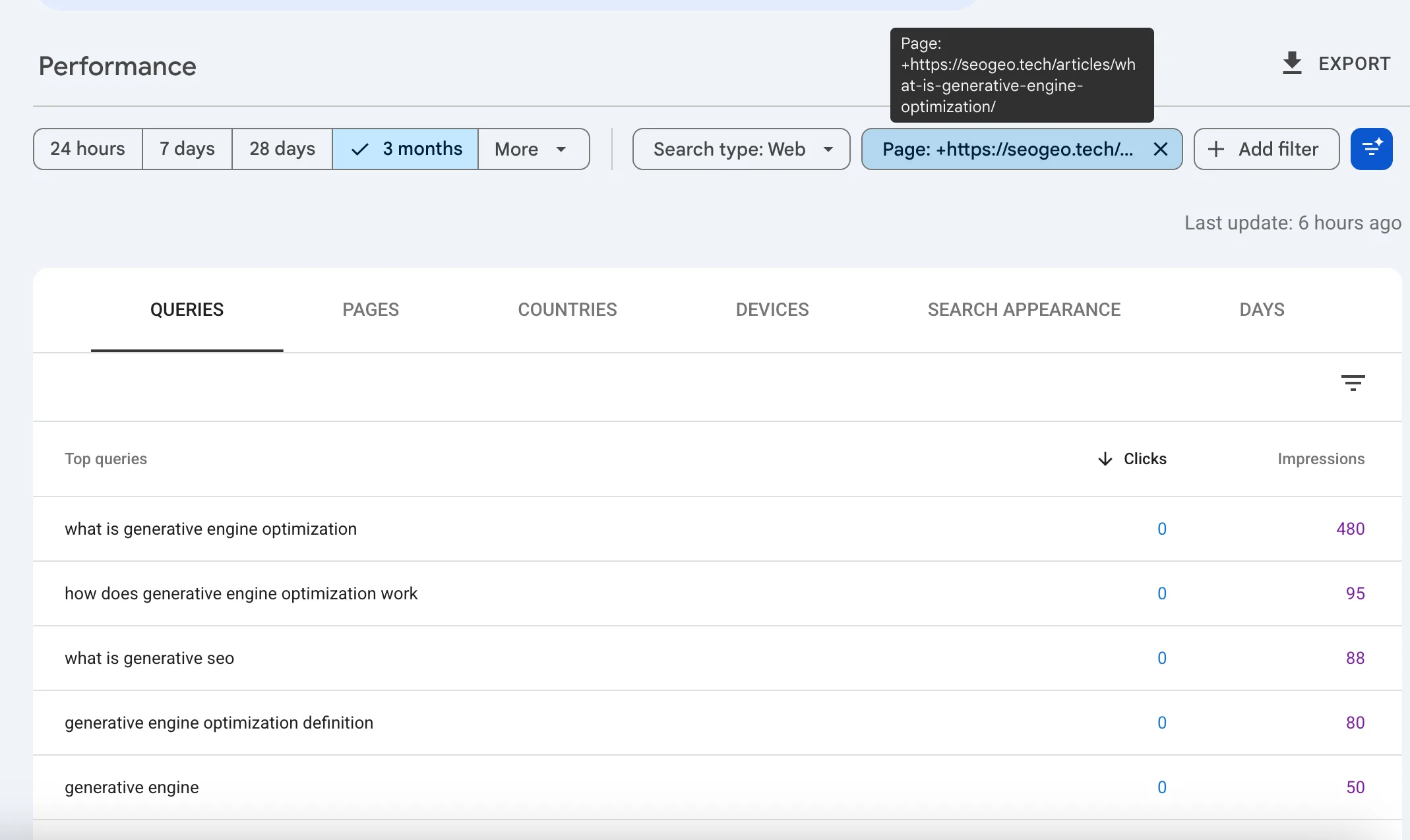
The screenshot records “what is generative engine optimization” with 480 impressions and “generative engine optimization definition” with 80. Both have zero clicks. For mapping purposes, the important fact is their wording: both ask for the meaning of the same concept. I assign them to the existing definition page, not to two separate briefs.
The 95-impression query “how does generative engine optimization work” needs more care. It can ask for a conceptual explanation rather than installation instructions. A short explanation of retrieval, interpretation, and attribution can belong beside the definition. Detailed checks on HTML, canonical URLs, and structured data belong in the Technical GEO guide. The word “how” alone is not enough to decide the destination.
The map I would hand to an editor
The first three phrases appear in the screenshot above. The final query comes from a separate saved Search Console report filtered to the Content Refresh Workflow URL, reproduced below. “URL in saved GSC report” identifies the page filter for each observation, not an exclusive ranking destination or a claim about today’s results.
| Observed query | URL in saved GSC report | Editorial destination | Decision |
|---|---|---|---|
| what is generative engine optimization | GEO definition page | The same GEO definition page | Keep the existing page as the destination for the definition. |
| generative engine optimization definition | GEO definition page | The same GEO definition page | Serve both phrasings together; do not create a separate page. |
| how does generative engine optimization work | GEO definition page | Definition page, linking to the Technical GEO guide | Explain the concept briefly, then hand off detailed implementation. |
| which geo platforms include a content refresh workflow for existing pages? | Content Refresh Workflow page | No suitable product-comparison page assigned | Verify product capabilities before deciding whether to create a comparison article. |
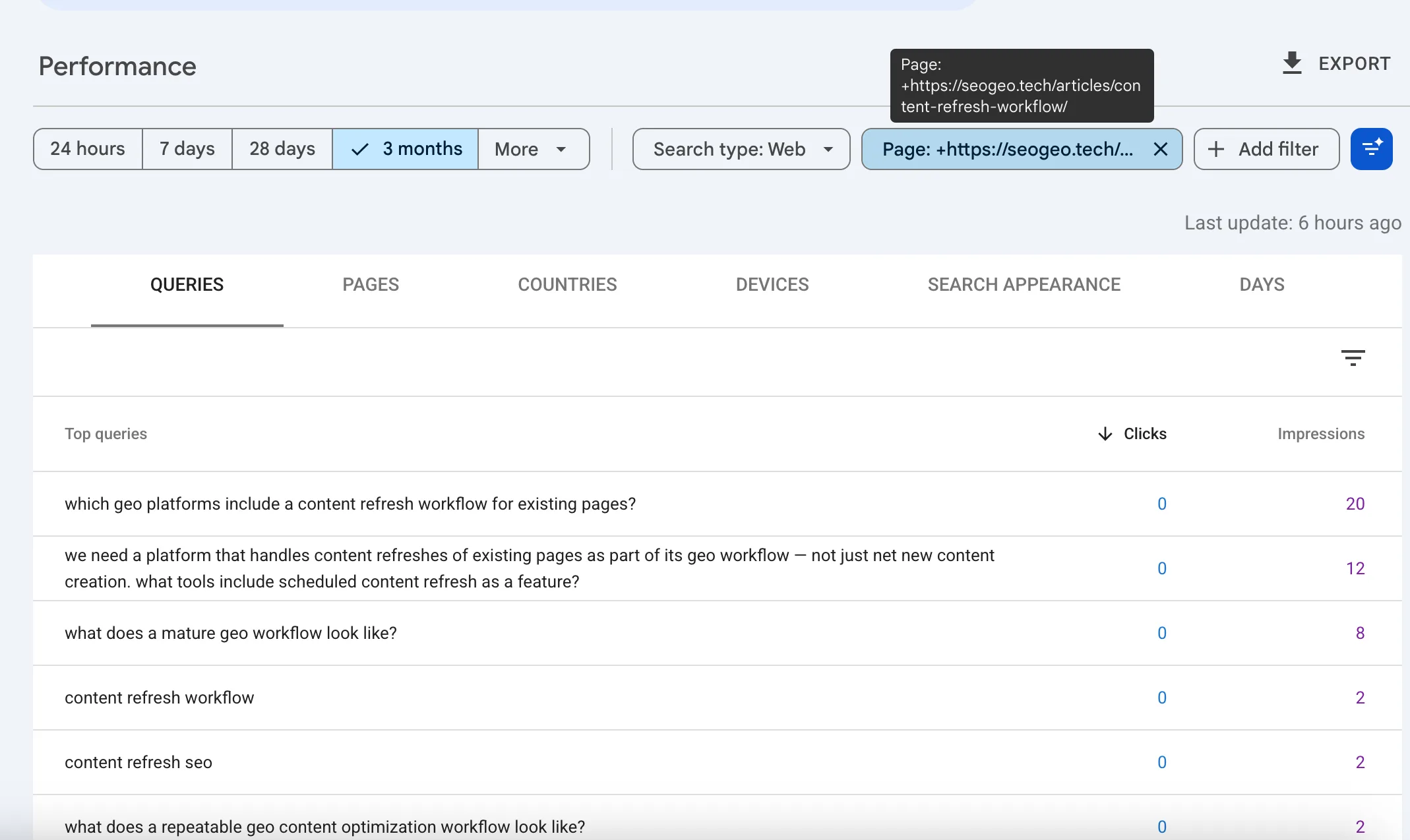
The last row is deliberately unassigned. The report records a software-selection question that the refresh article does not answer. The site does not yet have verified product-comparison content for this query. Putting it in the map as “covered” would conceal a mismatch; I would need product research, a comparison scope, and evidence for the capabilities being compared before assigning a new page.
An unassigned row is useful. It distinguishes a question the site could eventually answer from a question it can answer well now.
What belongs in a brief after the URL is chosen
For the definition page, I would write the brief like this: answer what GEO means immediately; explain what the term covers; use one short example; link to the comparison article when the reader asks how it relates to SEO. Do not expand it into another implementation manual.
That last sentence is as important as the topic. Without a stopping point, every GEO brief can acquire the same sections about schema, internal links, measurement, and FAQs. The pages then differ in keyword but not in purpose.
For an actual implementation request, the brief changes: help someone inspect or change a page, and show enough detail to complete that task. For a comparison request, explain the choices and their consequences. The SEO vs GEO article already has that comparison job. It does not need to be recreated inside the definition.
Before treating this map as a current work queue, I would refresh the query data and inspect which URLs appear for each query under consistent filters. Both saved screenshots are page-filtered: they do not show whether another URL also received impressions. Their exact date intervals cannot be recovered from the images, so they are not a fully reproducible dataset. Nor do their counts measure the total search volume for those phrases. Zero clicks is a reason to investigate position and result presentation separately, not a reason to assign another URL.
The finished map should make the next brief narrower. In this example, two definition phrases share a page, a broad “how” question gets a bounded explanation and a handoff, and a software-selection question stays unassigned. That is more useful than turning four rows into four articles.